An expert, operations-first guide for manufacturers to select an ERP in 2026. It translates strategy into measurable requirements, defines testable selection criteria and features, clarifies deployment and licensing choices, and outlines a disciplined due‑diligence and implementation approach to de‑risk the investment and accelerate ROI.
Introduction
Selecting an Enterprise Resource Planning system in 2026 is as much an operations and financial decision as it is an IT one. The right choice should compress lead times, improve OTIF, reduce scrap and cost‑to‑serve, and give leaders real‑time control of the plant and supply chain.
This guide walks you step‑by‑step through defining measurable requirements, weighing deployment and licensing options, evaluating modern capabilities, APS, quality, traceability, analytics, and shop‑floor connectivity, and running a disciplined due‑diligence and rollout that de‑risks the investment and accelerates ROI.
Key takeaways for 2026
Use these as filters for every discussion, demo, and proposal.
- Prioritize production planning and APS depth, real-time inventory and traceability, robust quality and financials, strong user experience with mobile data capture, and ecosystem fit proven through practical, testable capabilities.
- Match deployment and licensing to control, scalability, IT burden, and cost profile by weighing on‑prem for control, cloud for flexibility, SaaS for lowest IT overhead, and perpetual vs. subscription based on cash flow and total cost of ownership.
- Run a disciplined process with RFI/RFP scoring, scripted demos using your data and edge cases, reference checks and site visits, a security review, and proof of value before contracting.
- Consider QAD for manufacturing-centric ERP needs: its deep roots in discrete and process manufacturing, strong production and quality modules, global compliance support, and industry-specific cloud capabilities make it an excellent fit for complex, regulated environments where operational precision and scalability are critical.
Start with strategy: define objectives, manufacturing modes, and success metrics
Anchor ERP selection in business outcomes. Before you look at screens, define the improvements you need in throughput, quality, lead time, inventory turns, and cash conversion. Then translate those into measurable targets that become your acceptance criteria and ROI baseline.
Clarify your operating modes: Engineer‑to‑Order (ETO), Make‑to‑Order (MTO), Make‑to‑Stock (MTS), Configure‑to‑Order (CTO), process, repetitive, or job shop. Each mode changes the requirements: ETO needs deep engineering handoff and project accounting; MTS involves demand planning accuracy; mixed‑mode requires flexible BOM and routing structures.
Build a cross‑functional selection committee with operations, quality, supply chain, finance, and IT, backed by executive sponsorship. Define governance, decision rights, and a scorecard so trade‑offs are explicit and tied to Return on Investment (ROI).
- Document top bottlenecks across production, inventory, quality, and finance.
- Prioritize objectives like cost‑to‑serve reduction, OTIF improvement, and scrap reduction.
- Classify manufacturing modes and variation drivers to shape feature needs.
- Translate goals into measurable KPIs and target improvements (e.g., +15% throughput, −20% WIP days, +3 turns).
- Create a cross‑functional selection committee with executive sponsorship and clear decision rights.
ERP selection criteria for manufacturers in 2026
Focus on capabilities you can verify. Production planning and Advanced Planning and Scheduling (APS) must handle constraints, finite capacity, alternate routings, sequence‑dependent setups, and what‑if scenarios. Insist on realistic scheduling that considers labor, tools, and materials simultaneously, not just pretty Gantt charts.
Inventory and traceability should be real‑time with lot/serial control, backward/forward genealogy, and warehouse execution that supports directed putaway, picks, cycle counts, and mobile data capture. Validate that BOM explosion and backflushing align with your materials policies and that exceptions trigger alerts.
Quality management must be embedded: inspection plans, NC/CAPA workflows, SPC, and digital audit trails. Compliance needs differ by industry, but you should expect e‑signatures, revision control, and immutable logs. On the finance side, look for robust costing (standard, actual, average), variance analysis, and multi‑entity consolidation with intercompany eliminations.
User experience is a performance issue. Role‑based dashboards, KPIs, and mobile UX on the shop floor drive adoption and data quality. Confirm that power users can build no‑code analytics from production, quality, and finance data and that OEE metrics are available without heavy customization.
Key features checklist: what a modern manufacturing ERP must include
Use this checklist as a starting point to qualify fit. It focuses on features that influence day‑to‑day execution and margin control while minimizing custom work. You will need to augment based on your organization’s requirements and objectives.
Finite scheduling and capacity planning must respect constraints and simulate alternatives across machines, labor, and materials. What‑if capabilities should show the impact on promises, overtime, and expedite costs.
Shop‑floor connectivity, scanning, terminals, and machine data, should feed Overall Equipment Effectiveness (OEE) and trigger alerts, while supplier collaboration and embedded analytics make performance visible in real time.

Tech trends shaping ERP in 2026: AI, IoT, cloud, and security
AI is moving from pilots to practical gains: demand forecasting that reduces bullwhip, inventory optimization that balances service and working capital, and anomaly detection that flags scrap risks and maintenance issues earlier. Expect AI‑assisted scheduling that proposes feasible plans under tight constraints.
IoT sensor integration extends visibility from machines to ERP. Machine data drives predictive maintenance, real‑time OEE, and automatic production reporting that reduces manual entry. The value comes from closed‑loop actions, alerts that create work orders or reschedule automatically.
Cloud and Software as a Service (SaaS) improve scalability, update cadence, and time‑to‑value while lowering upfront costs. In parallel, zero‑trust security, encryption, and compliance automation are table stakes; evaluate them with the same rigor as functional features.
AI + IoT + cloud are only valuable when tied to measurable outcomes: higher OTIF, fewer stockouts, shorter lead times, lower TCO, and faster payback.
Deployment and licensing decisions: on‑prem, cloud, or SaaS; perpetual vs. subscription
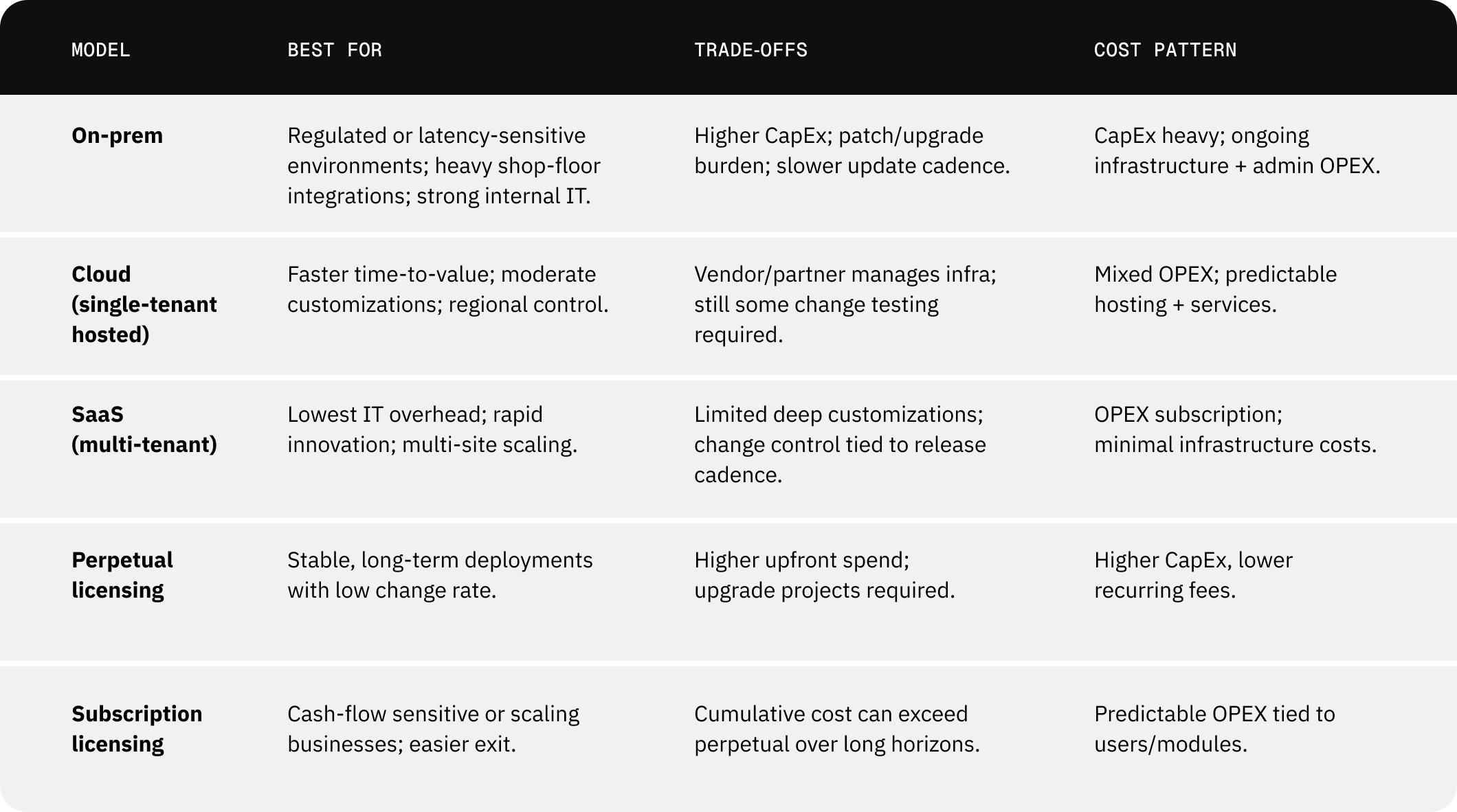
Choose deployment based on control, latency, regulatory posture, and IT capacity. On‑prem delivers maximal control and can address strict data residency or low‑latency machine connectivity, at the cost of higher internal support and slower upgrades.
Cloud hosting offers flexibility, elastic scaling, and faster time‑to‑value while retaining more control than multi‑tenant SaaS. SaaS minimizes IT overhead and provides frequent updates with predictable OPEX, but may limit deep customizations and require disciplined change management.
Licensing should match cash flow and horizon. Perpetual licenses concentrate costs upfront and can lower long‑run Total Cost of Ownership (TCO) for stable footprints. Subscriptions align expense to value realization, favor multi‑site growth, and reduce risk if needs change.
Integration architecture and openness: PLM, MES, WMS, and APIs
Your ERP will sit at the center of a digital thread. Favor systems with open, well‑documented Application Programming Interfaces (APIs), REST, webhooks, and event streaming, for near real‑time flows without brittle customization.
Validate native connectors for Product Lifecycle Management (PLM)/CAD, MES, WMS, CRM, and supplier portals. Confirm BOM, routing, and item master structures align so engineering handoff is clean and versioned, and that routings and work centers synchronize without rekeying.
Plan master data governance: define ownership, golden records, and reference data synchronization cadence. Poorly governed items, BOMs, vendors, and customers will torpedo scheduling accuracy and financial integrity.
Probe the roadmap and modularity. You want the option to add capabilities, APS, quality, warehouse, analytics, without invasive custom code. Evaluate data models, extension frameworks, and upgrade‑safe configuration patterns.
Security, compliance, and data governance
Set baseline security expectations: role‑based access control, SSO/MFA, least‑privilege policies, and encryption in transit and at rest. Ask how identities are managed across plants and partners and how access is audited.
Auditability matters for quality and regulated environments. Expect comprehensive change logs, e‑signatures, and CFR Part 11–style controls where applicable, with timestamped, immutable trails for master data, BOM/ECN, and production records.
Disaster recovery and data sovereignty should be explicit: backup frequency, Recovery Point Objective (RPO), Recovery Time Objective (RTO), and geo‑redundancy. Confirm data residency options, supplier compliance tracking, and how the platform supports investigations without performance penalties.
Costing the program: TCO, ROI, and budgeting for implementation
Build a Total Cost of Ownership (TCO) model over 3–7 years that includes licenses/subscriptions, infrastructure, implementation, integrations, data migration, testing, training, and support. Model scenarios for single‑site vs. multi‑site and conservative vs. accelerated adoption.
Quantify benefits tied to your KPIs: inventory turns, throughput, scrap reduction, labor efficiency, expedited freight reduction, and faster period close. Translate improvements into cash and margin effects to estimate payback and Return on Investment (ROI).
Budget realistically for data cleansing, cutover, and hypercare. Data preparation is the hidden critical path; plan for item, BOM, routing, vendor, customer, and on‑hand cleanses with validation cycles.
Reserve contingency for reporting, edge‑case integrations, and incremental training. Treat analytics as part of scope—operational dashboards and finance reports drive adoption and illuminate value realization.
- TCO line items: software, services, integrations, data migration, testing, training, change management, support.
- Benefit levers: +turns, −WIP, −scrap, −overtime, −expedites, +OTIF, faster close.
- Scenarios: single vs. multi‑site, phased vs. big bang, on‑prem vs. SaaS.
- Governance: track budget vs. value with quarterly KPI reviews.
Vendor due diligence and selection process
A disciplined process reduces risk and bias. Start broad with an RFI, score against must‑haves, and shortlist 2–3 options for deeper evaluation. Use a weighted scorecard aligned to your objectives.
Run scripted demos using your data, BOMs, routings, and edge cases. Include exceptions: late supplier ASNs, machine downtime, ECN mid‑build, and intercompany transfers. Record outcomes and time‑to‑complete for apples‑to‑apples comparison.
Perform reference checks in your sub‑vertical and footprint. Visit sites to see shop‑floor data capture, scheduling discipline, and inventory accuracy in the wild. Pair this with a security review covering identity, encryption, DR, and compliance posture.
Before contracting, execute a proof of value to validate performance at scale, integration fit (APIs), and operational usability. Negotiate SLAs, uptime, support response, and roadmap commitments tied to measurable acceptance criteria.
- Issue an RFI/RFP with prioritized requirements and scoring weights.
- Conduct scripted demos using your data and edge cases.
- Score fit, risk, and TCO/ROI across functional, technical, and operational dimensions.
- Run security and compliance reviews; validate APIs and integration patterns.
- Check multiple references and conduct site visits where possible.
- Execute a proof of value with success criteria and load/performance checks.
- Align on implementation plan, roles, and change‑management approach.
- Negotiate SLAs, uptime, support tiers, and commercial terms.
Implementation approach: phased rollout, change management, and training
Favor a phased, value‑led rollout. Start with a pilot plant or a module that solves a high‑pain area, planning, inventory accuracy, or quality, so users see quick wins and momentum builds.
Prepare data migration early with repeatable extracts, cleanses, and validation cycles. For critical processes, plan parallel runs to compare outputs and stabilize before cutover. Define clear entry/exit criteria for each phase.
Establish a super‑user network and role‑based training paths. Blend classroom, on‑the‑job, and quick‑reference guides. Measure adoption with usage telemetry, data completeness metrics, and cycle‑time deltas.
Define hypercare with SLAs and triage, then transition to steady‑state governance. Hold monthly ops‑finance reviews to track KPI movement against your ROI model and to prioritize incremental improvements.
Frequently Asked Questions
What criteria should manufacturers use to select an ERP system in 2026?
Prioritize APS depth, real‑time inventory and traceability, embedded quality, robust financials with multi‑entity support, and strong UX with mobile data capture—plus open APIs for PLM/MES/WMS integration and security that meets zero‑trust expectations. Verify each with scripted demos using your data and edge cases.
How should manufacturers compare cloud, SaaS, and on‑prem ERP and licensing models?
On‑prem maximizes control and can serve latency‑sensitive or regulated environments but raises internal IT burden and CapEx. Cloud hosting offers flexibility and faster time‑to‑value with moderate control. SaaS minimizes IT overhead and speeds updates. Perpetual licensing suits stable horizons with higher upfront cost; subscription aligns expense to value and scaling but may cost more over long horizons. Balance choices against TCO, ROI, and governance needs.
Which process best de‑risks ERP vendor selection and ensures ROI?
Run an RFI/RFP with weighted scoring, conduct scripted demos using your data, perform reference checks and site visits, complete a security review, and execute a proof of value with measurable success criteria before contracting. Tie decisions to KPI targets and a 3–7 year TCO/ROI model.
What KPIs should we track to validate ERP value post‑go‑live?
Track OTIF, lead time, inventory turns, WIP days, schedule adherence, OEE, scrap and rework rates, plan vs. actual labor and material variances, expedited freight, days to close, and user adoption metrics. Compare against pre‑implementation baselines to quantify ROI.
How long should ERP selection and implementation take for a manufacturer?
For a mid‑size single‑site manufacturer, expect 8–12 weeks for selection (RFI/RFP, demos, PoV) and 6–9 months for phased implementation of core modules. Multi‑site or complex ETO footprints can extend to 12–18 months. The critical accelerators are clean data, decisive governance, and a focused scope for the first phase.