
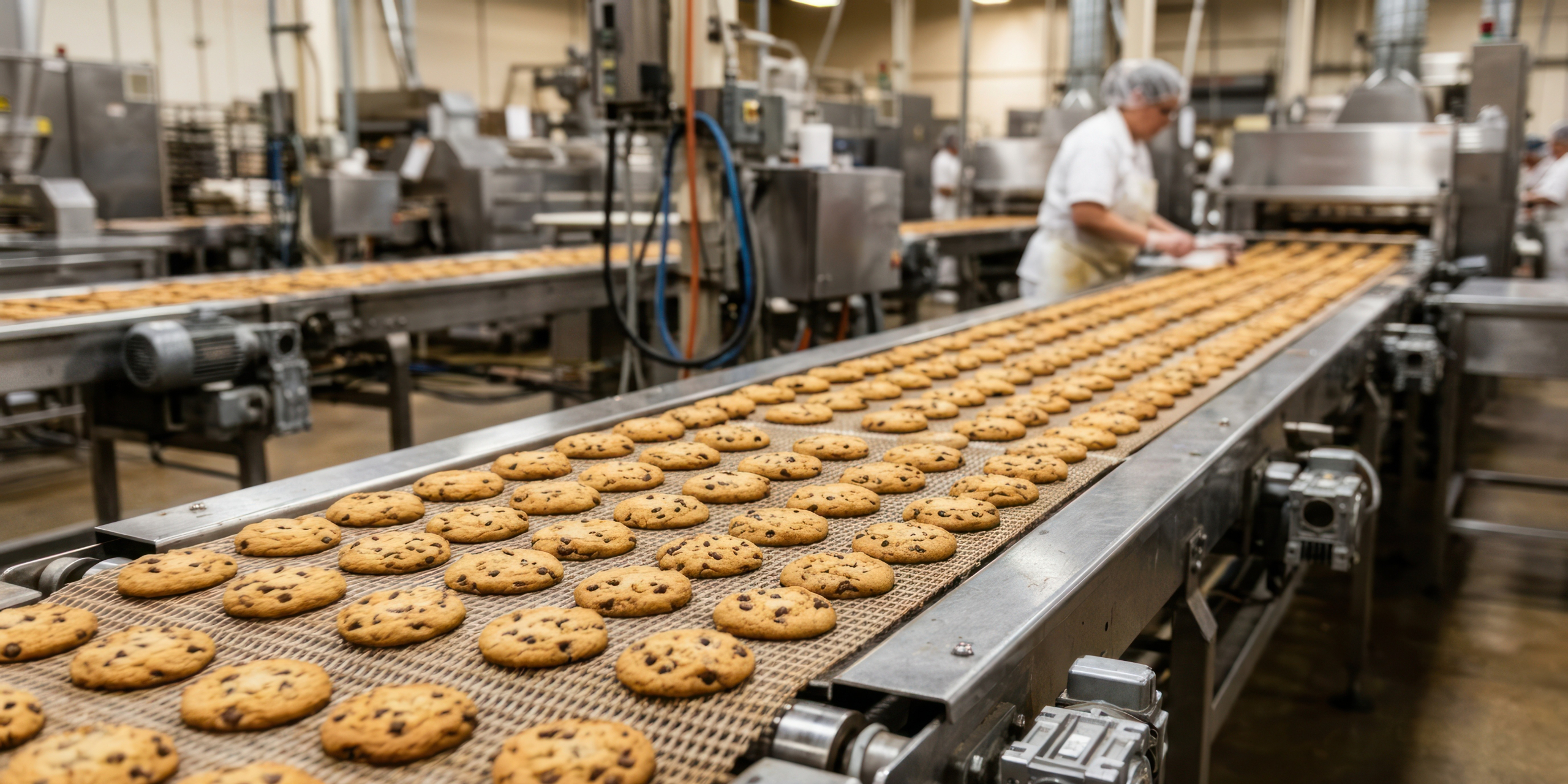
In food and beverage manufacturing, doing nothing is not a neutral decision, it’s an expensive one.
Rising costs, increasing regulatory pressure, and growing supply chain complexity are exposing the limitations of legacy ERP systems. What once felt “good enough” is now quietly eroding margins, increasing risk, and slowing down decision-making at a time when speed and precision matter most.
The challenge isn’t always obvious. Many of these costs don’t appear as a single line item on a P&L. Instead, they show up as operational drag; waste, inefficiency, compliance exposure, and missed opportunities.
And across the industry, the data confirms it.
- 78% of food manufacturers reported rising total cost per product in 2025, with an average increase of 13% (Source: Food Engineering, 2025)
- 48% of suppliers still rely on manual spreadsheets, with 39% reporting data entry errors (Source: TraceGains, 2024)
- 571 food recalls were recorded in 2025—a nine-year high (Source: Just-Food, New Food Magazine)
These challenges aren’t isolated, they’re systemic and often intensified by legacy systems.
The Hidden Cost of Legacy ERP
Traditional ERP systems were designed to record transactions, not to drive action.
They serve as systems of record. They house master data and capture what already happened. Thank you for the information I already know! They struggle to support what manufacturers need today: real-time visibility, predictive insights, and coordinated execution across operations. Manufacturers need systems to help them make accurate decisions quickly, not bog them down with more data that is possible to sift through.
In food manufacturing especially, the gap is widening. The industry operates under conditions that legacy systems weren’t built to handle:
- Variable ingredient costs
- Short shelf lives
- Strict lot traceability requirements
- Multi-site operations with complex dependencies
When these realities collide with outdated technology, the result is inefficiency that compounds over time.
Five Cost Areas Where “Doing Nothing” Hurts Most
1. Inventory Waste and Spoilage
Food manufacturers lose an estimated 7% of annual sales to surplus and waste (Source: ReFED, 2024).
For a $200 million company, that’s up to $14 million annually, often driven by poor demand signals, disconnected inventory systems, and slow response to disruptions.
Without real-time insight and coordination, excess inventory builds quickly, and expires just as fast.
2. Recall Risk and Traceability Gaps
Food recalls are increasing in both frequency and cost. The average recall event carries $10 million in direct expenses, excluding legal, regulatory, and reputational damage (Source: Just-Food, New Food Magazine).
Labeling errors alone accounted for 45.5% of recall events, costing an estimated $1.92 billion (Source: New Food Magazine).
Legacy systems make this worse. When lot traceability is fragmented and labeling processes rely on manual input, identifying the scope of an issue becomes slower and more expensive.
3. FSMA 204 Compliance Pressure
The FDA’s Food Traceability Rule (FSMA 204) requires manufacturers to provide detailed, electronic traceability records within 24 hours of a request.
The compliance deadline is now set for July 2028, may seem distant, but in reality it is closer than you think.
This is not just a regulatory update; it’s a structural shift. Many manufacturers today simply do not have the systems in place to meet this requirement, particularly those relying on spreadsheets or disconnected applications.
Every audit today requires manual effort. In the future, compliance will require continuous, automated traceability.
4. Labor Inefficiency
Labor costs are expected to rise by 11% on average, with 64% of manufacturers anticipating increases (Source: Food Engineering, 2025).
Yet much of the work inside manufacturing organizations is still manual:
- Data entry
- Spreadsheet reconciliation
- Manual planning adjustments
- Audit preparation
These activities don’t just consume time, they limit scalability and increase the risk of errors.
5. Slow Financial Close and Decision Lag
Only 18% of finance teams close their books within three days, while many take more than five (Source: Ledge.co, 2025).
That delay has a ripple effect. When financial and operational data isn’t aligned in real time, decision-making slows down, and opportunities are missed.
In a volatile market, delayed insight is a competitive disadvantage.
From System of Record to System of Action
What manufacturers need now is not just better data, but better execution.
This is where the shift from a system of record to a system of action becomes critical.
A system of action doesn’t just capture information. It:
- Connects data across the enterprise
- Provides real-time visibility
- Enables faster, more informed decisions
- Drives coordinated execution across teams
This is the foundation of modern manufacturing.And it’s where platforms like QAD Adaptive Applications come into play.
How QAD Enables the Shift
QAD’s portfolio is designed to help manufacturers move beyond legacy limitations and operate with greater agility, visibility, and control.
- QAD Adaptive Applications provide real-time operational visibility and embedded workflows that help teams respond quickly to change
- ChampionAI brings predictive and prescriptive intelligence into daily operations—helping manufacturers anticipate issues and take action before they escalate
- QAD EQMS (Enterprise Quality Management System) strengthens compliance, audit readiness, and quality processes that are critical for FSMA 204 and beyond
- QAD SRM (Supplier Relationship Management) improves supplier collaboration, traceability, and data accuracy across the supply chain
Together, these capabilities support a more connected, responsive, and intelligent manufacturing environment.
ChampionAI as a Profitability Engine
Artificial intelligence is not just an innovation layer, it’s becoming a profitability driver.
In manufacturing environments, AI can:
- Predict production disruptions before they occur
- Optimize scheduling and changeovers
- Reduce excess inventory
- Improve quality outcomes
- Accelerate decision-making
More importantly, AI transforms how organizations operate.
Instead of reacting to problems, manufacturers can anticipate and prevent them. Instead of relying on manual intervention, they can automate decision-making at scale.
This is where the real value lies. Not in dashboards, but in action.
The Cost of Waiting
The biggest risk for many manufacturers isn’t making the wrong move, it’s making no move at all.
Every month spent on outdated systems adds to:
- Waste and inefficiency
- Compliance risk
- Labor burden
- Missed opportunities
- Lower profits
And as regulatory deadlines like FSMA 204 approach, the window to act is closing.
Manufacturers that start now will have options. Those that wait will face compressed timelines, higher costs, and greater risk.
Final Thought
Every manufacturer already has data.
The question is whether that data is, are you using it to react or to win?
The future of food manufacturing belongs to organizations that can turn information into action, align systems with operations, and leverage AI to drive smarter, faster decisions. It is the companies that align their people, processes and systems intelligently and quickly. Those will be the winners.
Because in today’s environment, doing nothing isn’t standing still. It’s falling behind.
Champions move to the front of the line. Be a Champion.
Excellent insights. In today’s manufacturing environment, the cost of inaction often exceeds the cost of transformation. Turning data into action is becoming a key competitive advantage.
Thanks For Sharing the Insightful Information to in this Blog