Introduction
This section discusses overview information about Enterprise Asset Management (EAM).
Asset Lifecycle Management
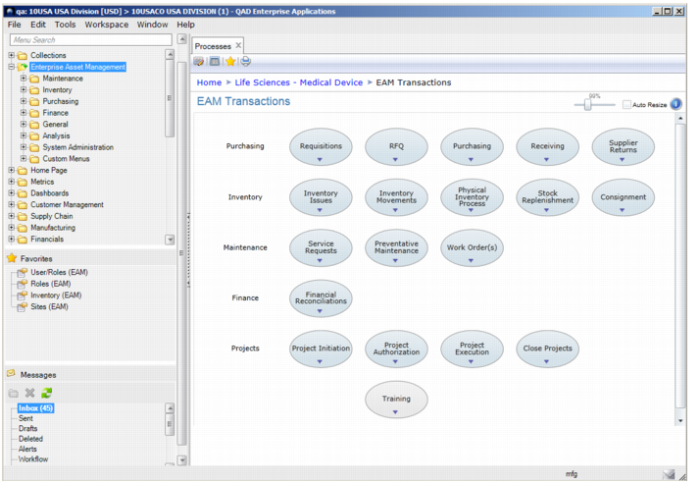
Use QAD Enterprise Asset Management (EAM) to effectively manage your organization’s physical assets. The EAM suite of applications maximizes manufacturing equipment use and minimizes repair costs. Lifecycle management includes design, construction, commissioning, operation, maintenance, and replacement of plant, equipment, and facilities. EAM provides supply chain management solutions for project accounting, plant maintenance, and maintenance, repair, and operation (MRO) including inventory and purchasing. EAM is fully integrated with the Manufacturing and Financial modules in QAD ERP.
EAM
EAM Business Areas
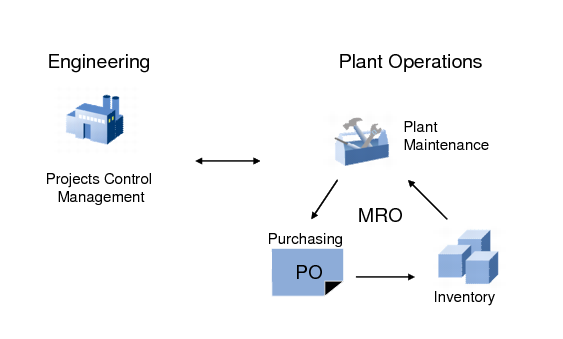
EAM consists of three primary business areas:
• MRO
• Project Controls
• Plant Maintenance
MRO Inventory and Purchasing
Storeroom managers use MRO Inventory to determine the critical parts to stock, minimizing production downtime and inventory investment. A company cannot stock all potential spare parts that may be required, because of the sheer number and cost.
Buyers use MRO Purchasing to quickly and easily identify the appropriate supplier with the best price. A small manufacturing plant may purchase thousands of MRO items from hundreds of potential suppliers. The electronic authorization process enables managers to review purchase requests and current spending against budget to determine whether to fill the requisition.
Project Controls Management
Expanding or upgrading manufacturing capabilities is one of the most important annual investments a manufacturing company makes. Bringing projects in on time and within budget is critical to ensure that the asset generates a return on investment. Project engineers use EAM to track and manage spending against a project’s budget and authorized spending authority. With real-time information, managers know how much has been spent and how much it will cost to complete a project.
Plant Maintenance
After the project is complete and plant operations takes control of the asset, maintenance planners use EAM to set up preventive maintenance schedules to properly maintain equipment. The EAM work order system records any repairs and associated cost against equipment. With this information, maintenance managers can determine how best to allocate resources.
EAM Application Framework
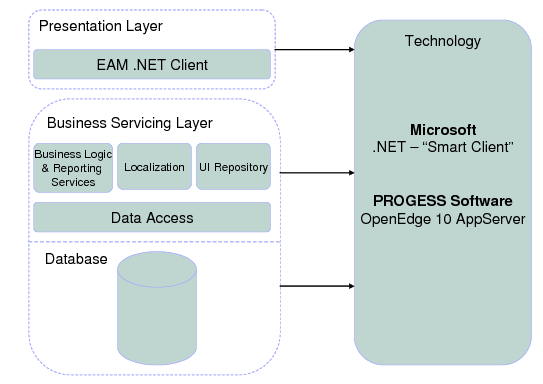
The EAM application framework is an Open Edge Reference Architecture (OERA) compliant system divided into three primary tiers, or layers. The topmost layer, or presentation layer, is a relatively thin client .NET executable designed to run on Windows XP and newer operating systems. The middle layer is based on OpenEdge technology and hosts all business services. The final layer represents databases and any other data source.
EAM Architecture
The presentation layer is a series of generic form, menu, browse, and action engines that render nearly every aspect of the user interface at runtime.
EAM