Formulas and Processes
The Formula/Process module defines and maintains the relationships between products, ingredients, and materials, as well as the processes required to manufacture a product in a batch.
IntroductionOutlines the Formula/Process Module and describes its relationship to batch numbers and lot control.
Defining FormulasDescribes how Formula Maintenance can be used to define new formulas and introduces additional fields to use with batches and items.
Defining ProcessesDescribes how Process Definition Maintenance can be used to define control information in terms of batches and introduces additional fields to use with processes.
Introduction
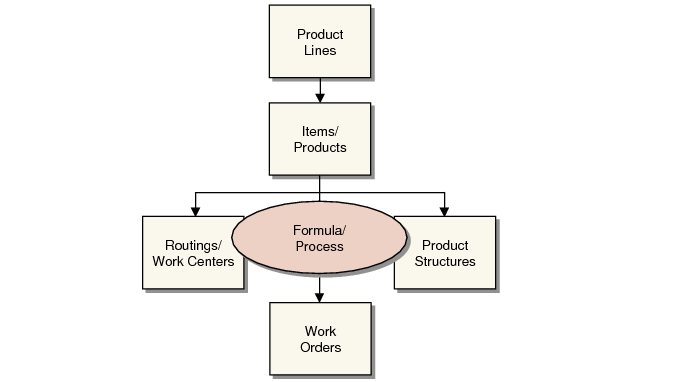
A formula (or recipe) is another way to define a product structure. A process definition is identical to a routing. In fact, there is no difference to the system between defining a set of operations in Routing Maintenance (14.13.1) or Process Definition Maintenance (15.13). Before you set up a process definition, you must set up the shop calendar, departments, and work centers.
Formula/Process Module
While Routing Maintenance sets up operation run time in hours per unit, and Routing Maintenance (Rate Based) (14.13.2) in terms of units per hour, Formula/Process lets you define a formula in terms of batch size and process it in hours per batch. The batch size is expressed in the parent item’s unit of measure and represents the quantity in which the item is to be produced.
In Formula/Process, all definitions reference a specific batch size. You can specify ingredient quantities as a quantity per batch or as percent of a batch. Process definitions are always expressed as run times per batch. Unlike product structures, formulas relate to a particular batch size.
The Formula/Process module also manages processes that create co‑products and by-products, along with the base process that produces them.
The Formula/Process module works in conjunction with lot/serial control, which is sometimes necessary to comply with government regulations. Lot control can also help companies improve quality, process control, and inventory accuracy.