Forecasting Simulation
Forecasting simulation functions enable you to analyze sales shipment history, calculate forecasts, and update demand for material requirements planning (MRP), creating a closed-loop system.
Forecasting simulation functions generate forecasts based on shipment history. They use statistical methods and extrapolation techniques to evaluate underlying patterns in sales history data and predict future demand.
Forecasting assumes that historical sales patterns are repeated to varying degrees in the future. The accuracy of any forecast depends on the value of the sales information used to create it. The more sales history available, the more accurate the forecast.
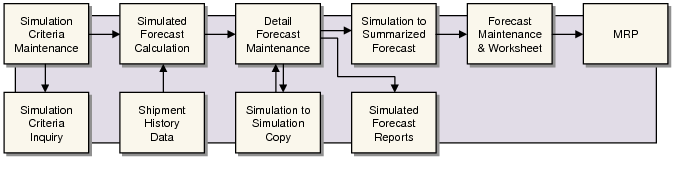
Forecasting Simulation Information Flow outlines the flow of information in forecasting simulation functions.
Forecasting Simulation Information Flow
Forecasting Horizon
Forecasts generated using forecasting simulation functions are produced in monthly buckets. They can either be for a given year or for the next 12 months, beginning with the current month. The latter is called a rolling forecast.
To produce a forecast for a given year, you must specify a forecast ending year that is earlier than the forecast year. To produce a 12-month rolling forecast beginning in the current month, the ending year must be the same as the forecast year.
Note: The system defines the first week of a new calendar year as the first Thursday in January, in accordance with ISO standards.