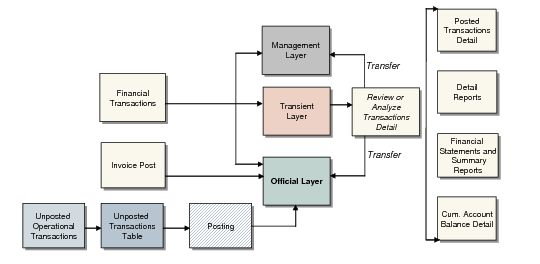
General Ledger Flow
The general ledger is a record of all transactions that occur in the entity. It is maintained by recording debit and credit transactions in a process known as posting. After posting, the balance of each account is updated, and the transaction becomes a permanent part of your financial records and cannot be modified directly. Account balances can, however, be changed using adjusting entries.
The posting process is controlled by associating daybook types with one of the three system-defined accounting layers: official, management, and transient. Accounting layers provide different ways of segregating transactions within a single GL account.
Although account balances are updated by transactions, an update does not always occur at the time of its corresponding transaction. Most operational GL transactions originate from manufacturing, purchasing, and inventory movement, and are created as unposted transactions. The system collects most operational transactions in an unposted transaction table that is not associated with an accounting layer. You can review the transactions to ensure that amounts, accounts, and dates are correct. Once the transactions are verified, you must post them to the official layer to update GL account balances. However, certain operational transactions, such as invoice post, are not collected in an unposted transaction table, and are posted directly to the official layer of the general ledger.
You can temporarily record unfinalized financial transactions in a transient layer for review and analysis. Transactions recorded in transient layers do not update account balances. When the records are verified, you can then post them by transferring them to the official layer.
Finalized financial transactions can be entered directly in the official layer using a single journal-entry process. During posting, the transaction detail in the posting line is used to update cumulative account balance detail records.
Once transactions are posted to the official layer, you cannot change or correct them directly. Use reversing transactions to make any required changes. See
Reversing Transactions.
The management layer is used for management accounts—for example, auditing adjustments—or for IFRS- and GAAP-specific requirements. Transactions recorded in the management layer do not affect account balances. See
Accounting Layers.
At the end of each GL period, it is recommended that you close the GL calendar for each transaction type to new activity. You cannot close a GL period if unposted transactions exist. Transactions are generally posted daily, although some organizations post weekly or monthly.
Posted transaction data remains in the system for detailed reporting. During posting, the transaction detail is used to update cumulative account balance detail records for the period. The account balance records are then used to generate financial statements and summary reports.
Most organizations print a trial balance summary or detail report before printing statements. The trial balance lists the title and amount for all accounts, making it easier to identify errors and make adjusting entries before printing formal statements.
After all reports are printed, you close the GL period to the general ledger. At the end of the fiscal year, the GL calendar year is also closed for the year, and the year-end close updates the retained earnings for the current year’s net profit or loss. See
Year-End Transactions.
In multiple currency entities, unrealized exchange gains and losses are calculated and posted prior to running reports. See
Revaluation.
The following figure shows the flow of data in the general ledger.
General Ledger Data Flow