Creating Customer Payments
Use the Customer Payment Create activities (27.6.4) to create, modify, view, and delete customer payments.
You cannot modify customer payments with a status of Bounced or Paid. Customer payments with a status of For Collection or Conditional Collection can only have the status field modified. You can delete only Initial customer payments. To delete a customer payment with a status other than Initial, you must first change the status to Initial.
Link the customer payment to an existing open item through allocation or create a prepayment. You can allocate items to a customer payment immediately by clicking Allocate or modify an initial payment to enable allocation at a later stage.
The following rules apply to customer payments:
• When you create a payment with a status other than Initial and do not link it to an open item, the system automatically creates a prepayment open item (CR) for the customer.
• You can adjust the prepayment and the invoice paid later using Open Item Adjustment Create.
• When you change a customer payment status to Bounced or Initial, open items are unlinked and reopened.
The Create Customer Payment To (Status) and Modify Customer Payment To (Status) activities let you control user access to the payment cycle.
For example, when you assign the Create Customer Payment To Accepted activity to a particular role, users assigned to that role can create payments with a status of Allocated or of Accepted only. The Status drop-down list is restricted to display the To Status and previous statuses in the flow. Subsequent statuses, such as For Collection or Paid Conditionally, are not available.
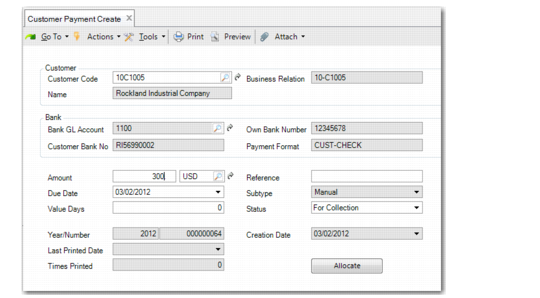
The Create Customer Payment To (Status) screen looks just like Customer Payment Create, but displays only those statuses for which your role has permission.
Customer Payment Create
Field Descriptions
Customer Code
Specify the code that identifies the customer making a payment. The system loads the customer’s default bank information defined in the Banking tab of Customer Create. Most bank details default from the bank and cannot be modified.
Business Relation, Name
This field displays the business relation and name associated with the customer.
Bank GL Account
Specify the GL account of type bank receiving the payment. If you specify a customer first, the banking details default from the customer. If you leave customer blank, the lookup retrieves all the bank account numbers and formats defined for all customers on the Customer Banking tab. Selecting a bank account fills in all of the other relevant fields, most in read-only mode.
Customer Bank No
This field displays the customer bank associated with the specified bank account.
Own Bank Number
This field displays the number of your own bank account, which is defined on the Banking tab of the customer record.
Payment Format
This field displays the payment format associated with the selected customer bank account number.
Amount/Currency
Specify the value of the payment in the transaction currency. The amount must be positive and can be entered manually or automatically by linking the payment to open items in the Allocation sub-screen. See
Allocating a Customer Payment.
Note: The payment currency must be the same as that of the open items against which you allocate the payment. If an invoice for this customer is in US dollars, your customer payment must be in the same currency.
Reference
Enter reference text (maximum 40 characters) for the payment. When the payment instrument is check, this is typically the check number.
A warning displays if a duplicate reference is specified for a customer.
Due Date
Specify the date on which the payment is receivable.
Value Days
Enter a value for the number of days required by the bank to process the transaction. The default number of days is retrieved from the payment status definition.
Subtype
This read-only field indicates that the payment is manual or automatic. You create manual customer payments through the Customer Payment activities, and automatic payments through the Customer Payment Selections.
Status
Choose a payment status from the drop-down list. The default for a new record is Initial (if you have created a payment status Initial for the type of payment).
Customer Payment Statuses and Account Activity lists payment statuses.
Year/Number
This field displays the accounting year and payment sequence number, which is automatically generated by the accounting year.
Creation Date/Last Printed Date/Times Printed
These read-only fields indicate the payment creation date, most recent printing date, and number of times the payment has been printed.
Click Allocate to allocate the payment to an open item.