Simulating Revaluation
The Revaluation Simulate activity (25.21.1.1) identifies the revaluations to be run for the GL periods and revaluation areas specified. You can also specify the source layers where the balances are calculated and the target layer where the revaluation is posted when you run Revaluation Post.
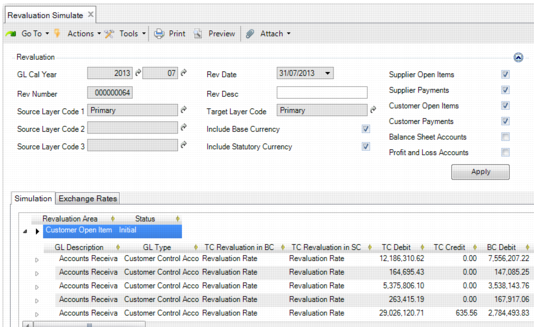
The Revaluation Scope settings let you identify specific types of accounts for which to run the revaluation process; for example, customer or supplier payment or control accounts, or balance sheet accounts. The account types you select are displayed in the Revaluation Area column of the simulation grid when you click Apply to begin the simulation. If the current entity is included in one or more entity groups, you can choose to run the simulation for the current entity or an entity group. For more information on entity groups, see
Setting Up Multi-Entity Processing.
The simulation results are displayed in a hierarchical grid. You can drill down for more detail on individual items. The results are grouped by revaluation area, and by transaction currency or by transaction currency/sub-account combination if you defined sub-account analysis for the system accounts.
The results display the following information:
• The original debit and credit amounts in TC, BC, and SC
• The revaluated debit and credit amounts in TC, BC, and SC
• The revaluation differences to be posted
• Analytical information, if you defined analysis on the accounts
When you have completed the fields, click Save to save the revaluation.
Both Revaluation Simulate and the Revaluation report include all transactions in the revaluation scope. In addition, transactions that have no revaluation impact are included; that is, transactions where the revaluation difference is zero because the historical rate is the same as the revaluation rate. By including all transactions in Revaluation Simulate and the Revaluation report, the system provides a complete reconciliation between the transaction amounts from before and after revaluation.
Revaluation Simulate
Field Descriptions
GL Calendar Year/GL Period
Specify the GL calendar year and period in which to revalue transactions.
Rev Number.
This field displays a system-generated sequence number for the revaluation. If you create a simulation for an entity group, the system generates a separate rev number for each entity in the group, and displays the rev number for the current entity.
You can view the rev number for the other entities by changing to that entity and opening the simulation in Revaluation View.
Revaluation Date
This read-only field indicates the last day of the GL period.
Revaluation Description
Enter a brief description (maximum 24 characters) of the revaluation.
Source Layer Code 1, 2, 3
Specify up to three source layers from which to revalue transactions. You can select official or management layer types.
Target Layer Code
Specify the layer in which the result of the revaluation is saved. The layer code you specify in the first source layer you set automatically defaults to the Target Layer Code field if this field is blank. However, you can overwrite this value.
You can select official or management layer types only.
Revaluation Scope.
Select the types of account to check for balances that are subject to revaluation.
Include Base Currency
Select this field to revaluate using the base currency.
Include Statutory Currency
Select this field to revaluate using the statutory currency. The statutory currency revaluation uses the statutory exchange rate, unless you have specified a different revaluation rate in the currency settings in GL Account Create (25.3.13.1). When using the statutory exchange rate, you have the option to revert to using the accounting exchange rate if the statutory rate is unavailable. The fallback option is set in Exchange Rate Type Create (26.3.1).
When you select this field and run simulation on an entity group, if some entities in the group do not have statutory currency enabled an error appears and Revaluation Simulate completes only for entities with statutory currency enabled.
The base currency revaluation and the statutory currency revaluation are not dependent. You can run the revaluations separately or together.
Simulate For
This drop-down menu contains the current entity, along with entity groups that contain the current entity, provided you have access to all of the entities within the entity group. Select the entity or group of entities that you want to apply the revaluation simulation to.
Important: If you add the current entity to an entity group for the first time, you must log out and log in again before the Simulate For field displays.
Note: The details that appear in the grid apply to the current entity only; if you want to see the details for each entity in the group, run the simulation entity by entity.
If you do not have role permission for Revaluation Simulate for all of the entities in the group, an error displays and Revaluation Simulate completes only for the entities for which you have the required role permission. Similarly, if the GL period is not open in all of the entities, an error displays for the relevant entity and Revaluation Simulate completes for the other entities.
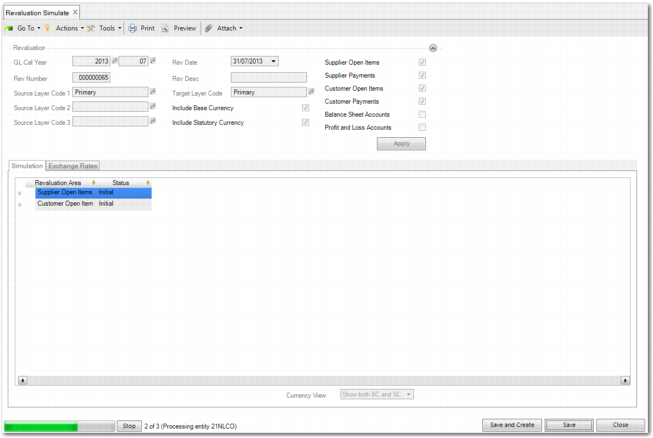
If you are running Revaluation Simulate for an entity group, a progress bar appears at the bottom of the screen to show the entity that it is currently working on, and how many entities remain to be processed. If you click Stop, Revaluation Simulate stops processing after the entity currently processing completes.
Exchange Rate Tab
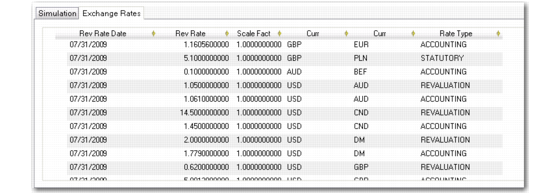
The Exchange Rate tab on the Simulate screen displays a read-only list of the exchange rates used in the revaluation.
Revaluation Simulate, Exchange Rate Tab
Revaluation Simulate with Progress Bar
Posting Revaluations
Use the Revaluation Post activity (25.21.1.5) to post the revaluation differences to the relevant accounts.
You can only post a revaluation after you have saved it in Revaluation Simulate. Revaluation Post processes one or more revaluation simulations, and creates the GL postings for them.
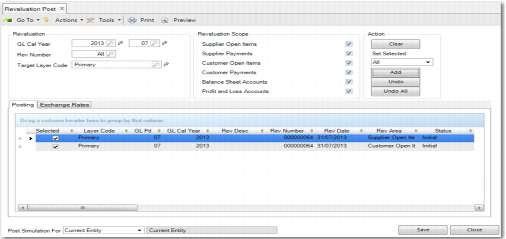
Select revaluations created using Revaluation Simulate for posting using the GL calendar year and GL period, revaluation number, layer, and revaluation scope items as search criteria. Click Add to add revaluations that match the criteria to the Posting grid.
Revaluation Post
Field Descriptions
GL Calendar Year/Period
Specify a GL calendar year and GL period in which to search for revaluation transactions.
Rev Number.
Specify a revaluation object number that identifies a simulation. If you run Revaluation Simulate for an entity group, the system generates a separate rev number for each entity in the group, and displays the rev number for the current entity.
Target Layer Code
Specify a target layer to search for revaluation simulations.
Revaluation Scope.
Select the types of account to include in the revaluation object search.
Set Selected
Use the drop-down list to include or exclude selected revaluations in the posting grid.
Use the Clear, Add, Undo, and Undo All buttons to clear the posting grid, and to add or remove revaluations from the grid.
Post Simulation For
This drop-down menu contains the current entity, along with entity groups that contain the current entity, provided you have access to all of the entities within the entity group. Select the entity or entity group that you want to post the revaluation to.
If you do not have role permission for Revaluation Post for all of the entities in the group, an error displays and Revaluation Post completes only for the entities for which you have the required role permission. If there are posting restrictions on either the current GL period or the next GL period for any of the entities in the entity group, an error displays when you run Revaluation Post. This is because the revaluation posting reverses in the next GL period.
When Revaluation Post runs on multiple entities, a progress bar appears at the bottom of the screen to show which entity is processing currently, and how many entities remain to be processed. If you click Stop, Revaluation Simulate stops processing after the entity currently processing completes.
Important: If you add the current entity to an entity group for the first time, you must log out and log in again before the Simulate For field displays.
To generate the revaluation and reversal postings, click Save.
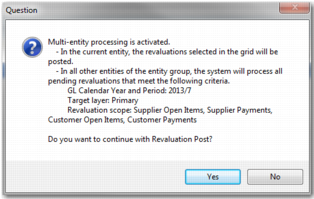
Note: When running Revaluation Post for an entity group, the system posts to the current entity based on the contents of the Posting grid. The system posts to other entities in the group based on the selection criteria specified in the search fields above the grid. If you search for revaluations and then clear the Selected field in one or more of the resulting rows in the grid, a message displays informing you of the difference in behavior when posting to the current entity and when posting to other entities in the group. If you want to continue with the postings, click Yes.
Revaluation Post Question