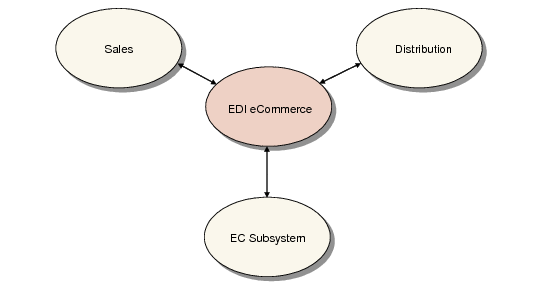
EDI eCommerce Overview
This chapter describes how EDI eCommerce exchanges business documents with external electronic commerce (EC) subsystems.
Introduction to EDI eCommerceIntroduction to how EDI eCommerce is an improved method of managing electronic data interchange (EDI) communications with trading partners.
Elements of EDI eCommerceDescribes the document repository. This tool set contains table definitions and transformation procedures required to integrate transactions and support table maintenance, import, and export. It also provides the document import and export process control functions.
EDI eCommerce ProcessingDescribes the processing actions required to convert between the EDI-oriented exchange file and the system-oriented business document.
Introduction to EDI eCommerce
EDI eCommerce is an improved method of managing electronic data interchange (EDI) communications with trading partners. It is the interface between the system and third-party EDI communications or translator products called EC subsystems.
EC subsystems send and receive EDI data files containing documents that support such products as QAD Sales. This packaged software performs electronic data communications for flat-file transfer. In the EDI eCommerce context, EC subsystems translate EDI data to and from the QAD standards-neutral formats (SNFs), which are defined for all inbound and outbound EDI documents.
EDI eCommerce Overview
EDI eCommerce’s table-based logical structure supports all major EDI standards, making the system compatible with most EC subsystem translation capabilities. Additionally, you can map inbound or outbound data in extensible markup language (XML) format—an important feature in making EDI communications interoperable with external systems.
Traditional EDI processing applications require program changes at the code level to meet the input and output requirements of external systems. In contrast, eCommerce’s processing logic, EDI document specifications, and trading partner specifications are stored in database tables. These tables can be modified through the user interface with a set of maintenance programs.
The import and export processes use gateway programs to move data into and out of the database. These programs are the same for all combinations of document type and trading partner. Specifications for trading partners and application document definitions are set up in tables instead of in the code.
EDI eCommerce also stores the EDI data in tables. This table-based approach enhances the system’s ability to manipulate, analyze, edit, and reprocess EDI documents.
Note: EDI eCommerce supports the EDI requirements of the Enterprise Material Transfer (EMT) module, which allows you to automatically generate purchase orders from sales orders and transmit them to lower-level suppliers. Use eCommerce programs to communicate the following types of EMT-related documents among trading partners:
• Purchase orders
• Purchase order acknowledgments
• Purchase order changes
• Purchase order change acknowledgments
• Advance ship notices (ASNs)