QAD 2017 Enterprise Edition
>
User Guides
>
Global Tax Management
>
Implementing GTM
>
Setting Up Tax Classes and Usages
Setting Up Tax Classes and Usages
Depending on your tax system, set up tax class and/or tax usage codes to accommodate differences in taxation within a tax zone. These codes apply to all domains in the database.
Tax Classes vs. Tax Usages lists some typical situations and describes how to implement them.
Tax Classes vs. Tax Usages
|
Situation
|
Implementation
|
|
Customers and/or suppliers in a tax zone are subject to different tax types or tax exemption types.
|
Set up tax classes for these customers and/or suppliers.
|
|
Product lines and/or items are subject to different tax types or tax exemption types.
|
Items are always subject to the tax types in the line item tax environment. There is no way to override this. You can set up tax classes for product lines and items. However, they are only used to select tax rates.
|
|
On sales transactions, trailer charges are subject to different tax types or tax exemption types.
|
Trailer charges are always subject to the tax types in the transaction tax environment. There is no way to override this. You can set up tax classes for trailer charges; however, they are only used to select tax rates.
|
|
Customers and/or suppliers are subject to different tax rates for a tax type.
|
Set up tax usages for these customers and suppliers.
|
|
Items are subject to different tax rates for a tax type.
|
If items have the same rates on all transactions, set up tax classes. However, if rates can differ by transaction, based on the intended usage of the item, set up the tax usage codes to reference during transaction entry.
|
|
Trailer charges are subject to different tax rates for a tax type.
|
Set up tax classes for these trailer charges.
|
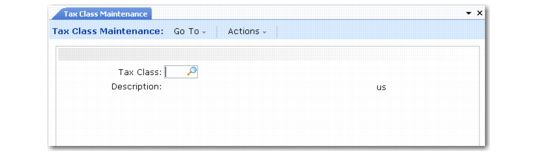
Set up tax class codes in Tax Class Maintenance (29.1.5). To verify data setup, use Tax Class Browse (29.1.6) and Report (29.1.7).
Tax Class Maintenance (29.1.5)
Tax Class
Enter a code (maximum 3 characters) that identifies a group of customers, suppliers, product lines, items, service categories, or trailer charges subject to special taxation.
• For customers and suppliers, the tax class helps determine the tax environment.
• For product lines, the tax class determines the tax rate for new items.
• For items, service categories, and trailer charges, the tax class helps determine the tax rate for tax types in the tax environment.
For more detailed tax exemption reporting, remember to set up tax classes for exemptions.
Description
Enter a brief (maximum 24 characters) description of the tax class. This field is required.
Multiple language descriptions are supported. See
Multiple Language Descriptions for details.
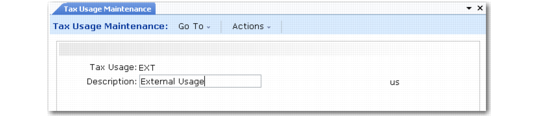
Set up tax usage codes in Tax Usage Maintenance (29.1.9). To verify data setup, use Tax Usage Browse (29.1.10) and Report (29.1.11).
Tax Usage Maintenance (29.1.9)
Tax Usage
Enter a code (maximum eight characters) that identifies a group of customers, suppliers, or items subject to special taxation on a specific transaction.
Description
Enter a brief (maximum 24 characters) description of the tax usage code. This field is required.
Multiple language descriptions are supported. See
Multiple Language Descriptions for details
The Legal Information frame is used to define legal requirements. To display this frame, select the Maintain Operation Type in Tax Usage field in Legal Document Control (7.10.24).
Sort Name
Specify up to 24 characters for the sort name.
Operation
Specify the operation type to associate with the tax usage.
Tax usages and their associated operation types are validated if you select the Maintain Operational Type in Tax Usage field in Legal Document Control. The inventory movement codes Transaction Type and Transaction Flow must be validated against the tax usage operation type. The operation types are as follows:
• 1 - Purchases: The operation type associated with tax usages referenced in purchasing transactions. This type causes the Physical Movement field to become active.
• 2 - Other Entries: The operation type associated with tax usages referenced in unplanned receipts. This type causes the Physical Movement field to become active.
• 3 - Sales Returns: The operation type associated with tax usages referenced in sales return transactions.
• 4 - Other Exit Returns: The operation type associated with tax usages referenced in returns subsequent to unplanned issues. This type causes the Physical Movement field to become active.
• 11 - Sales: The operation type associated with tax usages referenced in sales order transactions.
• 12 - Other Exits: The operation type associated with tax usages referenced in unplanned issues.
• 13 - Purchase Returns: The operation type associated with tax usages referenced in purchase returns.
• 14 - Other Entry Returns: The operation type associated with tax usages referenced in returns subsequent to unplanned receipts.
Second, Third, Fourth CFOP Digit
Enter the second, third, and fourth digits of the document used to print CFOP tax and registration details for the fiscal books.
Código Fiscal de Operações e Prestações (CFOP) codes are numeric codes that identify the nature of the operation for movement of goods and services from interstate and inter-site transportation.
The code represents the reason for the entry and exits of goods or products, as well as the related services that are being performed, according to the origin and destination of the goods.
CFOP Complement
Specify the complement of the document for printing CFOP tax and registration tax details on the books.
Suffix
Specify the suffix, which is an optional code used to group different tax usages or to differentiate between different fiscal situations for the fiscal interface.
Remarks
Specify up to 50 characters for comments on the legal document tax usage configuration.
End Consumer
This field is only available when the operation is 11-Sales or 3-Sales Returns. The field can have three possible values:
0 - Not applicable. The sales transaction does not involve an end consumer.
1 - End Consumer. The sales transaction involves an end consumer.
2 - ICMS Partition. The sales transaction involves an end consumer in the automotive industry.
Physical Movement
Select this field to indicate whether the tax usage involves physical movement.
This field only becomes editable if you select an operation type of 1 - Purchases, 2 - Other Entries, or 4 - Other Exit Returns.
For this function to work, you must activate a generalized code in Generalized Code Maintenance (36.2.13), as specified in
Generalized Code For Physical Movement Field.
Generalized Code For Physical Movement Field
Field Name | Value |
txu_phy_mov | 0 - No 1 - Yes |
NFe Usage
This field accepts 1 - no selected option, 2 - Complementary, 3 - Adjust, or 4 - Returns. During shipper creation, the corresponding field uses the setup specified here by default. This is not a mandatory field.