Processing Purchase Orders
When you create an order in Purchase Order Maintenance (5.7), Blanket Order Maintenance (5.3.1), or Scheduled Order Maintenance (5.5.1.13), you can specify the terms of trade. The same logistics accounting frames and fields are used in all three programs.
The system automatically copies terms of trade to the PO when orders are created by releasing a blanket order using Blanket Order Release to PO (5.3.6)
Note: When you use Build PO from Requisitions (5.2.18) to create a PO, the default terms of trade assigned to the item supplier are used. When default terms of trade are not found, logistics charges do not accrue for these orders. See
Assigning Terms of Trade to Suppliers.
After you enter the code for terms of trade, you can optionally display the detail lines for the terms of trade and assign a logistics supplier to each charge that is your (the customer’s) responsibility. Logistics charges that are the responsibility of the item supplier do not display.
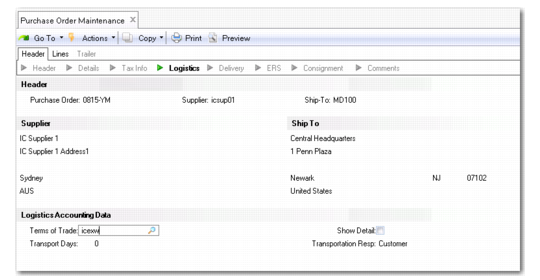
Purchase Order Maintenance, Logistics Accounting Data Frame
Terms of Trade
Enter the terms-of-trade code used to accrue logistics charges for this order. This field defaults from the terms-of-trade code associated with the supplier in Supplier Maintenance. When this field is blank, logistics charges do not accrue for this order.
Transportation Resp
Displays whether the customer or item supplier is responsible for arranging transportation.
Transport Days
When Transportation Resp is Customer, enter the number of calendar days to transport goods from the item supplier to the PO ship-to site. Defaults to the Transit Days value in Delivery Transit Time Maintenance (2.16.1) based on the PO supplier address and the ship-to site. When Transportation Resp is Supplier, this value must be 0 (zero).
Show Detail
Enter Yes to display details for the specified terms of trade.
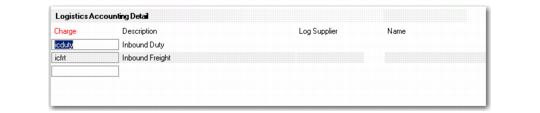
Logistics Accounting Detail Frame
Log Supplier
Enter the supplier of the selected logistics charge.
After you enter a PO line item, the system recalculates the PO line item unit cost to exclude logistics costs that are your responsibility, since they are not payable to the item supplier, except when one of the following is true:
• A price list with an amount type of L (list) is attached to the PO. The system uses the list price from the price table. Price lists are defined in Price List Maintenance (1.10.2.1). See
Using List/Discount Table Pricing.
• A supplier quote price is available. The PO line item unit cost defaults from the supplier quote price defined in Supplier Item Maintenance (1.19) for the item and supplier. See
Customer and Supplier Items.
Otherwise, the system checks the GL cost set for any cost element in the Material category for that line item. If a cost element is linked to a logistics charge code belonging to the PO terms of trade and the charge is your responsibility, the value of the cost element is excluded from the PO unit cost.
If you change the terms of trade or assign a different code to the PO, the system does not recalculate unit costs for existing line items. You can manually update the PO unit cost of each line item or use Purchase Order Cost Update (5.19) to automatically recalculate and update the unit costs.
Example: PO Unit Cost Calculations with Price Lists Applied shows how the unit cost of an item on a PO line is calculated when price lists are applied. In this example, the PO line item has a Material cost element with a value of $10 and a Freight cost element in the Material cost category with a value of $1 in the GL cost set. The PO terms of trade indicate that the customer is responsible for freight.
PO Unit Cost Calculations with Price Lists Applied
Price List | Amount Type | Price List Value | PO Unit Cost | PO Discount | PO Net Unit Cost |
PL1 | L (list) | $11.50 | $11.50 | 0.0% | $11.50 |
PL2 | D (discount) | 5.0% | $10.00 | 5.0% | $9.50 |
PL3 | P (price) | $6.66 | $10.00 | 33.4% | $6.66 |
PL4 | M (markup) | 7.5% | $10.00 | -7.5% | $10.75 |
When PL1 is used, the system uses the list price. When PL2, PL3, or PL4 are used, the system subtracts the value of the Freight cost element from the PO unit cost. If Logistics Accounting is not enabled, the PO unit cost is $11.
Note: It is recommended that price lists always be defined when using logistics accounting. Using price lists makes the system run more efficiently.
PO Shippers
When you use PO Shipper Maintenance (5.13.14) or PO Fiscal Receiving (5.13.16) to record PO line items and quantities listed on formal shipping documents or packing lists, the system prompts for additional logistics accounting information.
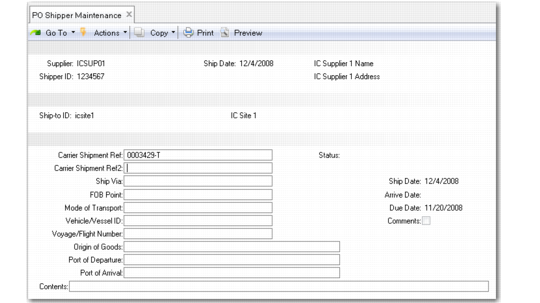
PO Shipper Maintenance (5.13.14)
Carrier Shipment Ref
Enter the shipment reference number from the carrier, such as a bill of lading number, carrier tracking number, or packing slip number. The shipment reference is used during receiver matching to help match pending invoices to invoices from logistics suppliers.
When terms of trade are assigned to POs attached to the shipper, each PO line must have the same terms-of-trade code assigned; otherwise, an error displays. The terms-of-trade code assigned to the first PO line is applied to the entire shipper or container.
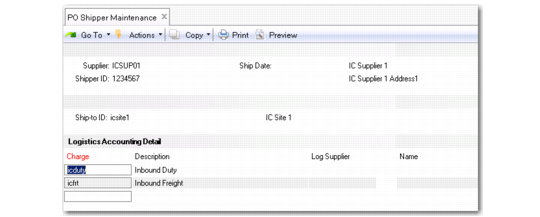
After you finish entering line items, the terms-of-trade details display. You can specify a supplier for each logistics charge that is your responsibility.
PO Shipper Maintenance, Logistics Accounting Detail Frame
Log Supplier
Enter the third-party supplier for this logistics charge.