Defining Performance Categories
The next step in setting up Supplier Performance is to define categories in Performance Category Maintenance (5.15.1). Supplier performance uses four predefined system categories to capture and associate event data.
• ASN Information
• PO Receipts
• DO Receipts
• RTS Receipts
You must create category definitions to use the data captured by system categories. The system uses the details from the category definitions you create to sort, calculate, and report on data captured by the corresponding system categories.
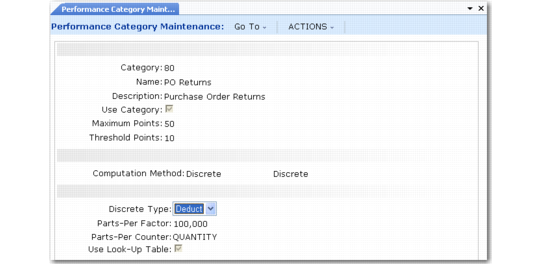
Performance Category Maintenance (5.15.1)
Aspects of the category you can customize include:
• Naming the category
You can use the predefined system category names or create names to fit your environment.
• Activating or deactivating categories
You can have multiple categories in your system but use only a subset of these. If you want to stop using a category without deleting it from your system, deactivate it in the Use Category field. If you want to stop reporting for a category without stopping data collection, use Supplier/Category Maintenance (5.15.3).
• Defining point values
Use Maximum Points to indicate the maximum allowable points for the category. Use Threshold Points to define the minimum number of points a supplier can have in the category before that supplier is considered deficient.
• Defining computational methods
Use Computational Method to indicate how performance points are calculated for the category.
Use Performance Category Browse (5.15.2) to view the categories you create using Performance Category Maintenance.
Using the Computational Methods
Categories are scored using one of three computational methods, each with its own attributes and purpose.
Discrete method
This method involves adding or deducting points from a category’s starting value or maximum points. The Discrete Type field determines if the event adds to or deducts from the supplier’s score. This method is commonly used with subjective categories, but can be used by all categories.
Proportion method
This method distributes the total points based on a number of occurrences captured. It takes into account the number of occurrences captured and the number of events captured. This supports manufacturers who, for example, determine that the number of deliveries should be factored into the rating on delivery.
Parts-per method
This method uses a factoring value (typically 1 million) to extrapolate the points awarded and produces a result that helps differentiate suppliers having almost perfect scores. The parts-per method includes a lookup table. The table contains the range of values for lookup and an associated percentage of category points.
Understanding the Lookup Table
When you are using the parts-per computational method you can create a reference lookup table. Set Use Lookup Table to Yes to create and use a lookup table for a supplier. The values you set up in this table are used by the Performance Report Card (5.15.15) to calculate the supplier’s score percentage.
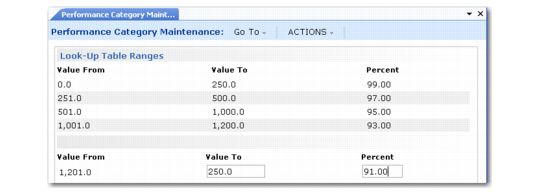
Performance Category Maintenance, Lookup Table Ranges Frame
Many manufacturing companies set specific performance guidelines for their suppliers. The lookup table is used when these guidelines indicate a parts per number.
One example of the lookup table’s use is:
• A company requires a supplier to have no more that 50 defective parts per million.
• For that company, the category Quality is worth 50 points on the report card.
• To manually calculate the parts per number, you take the actual number of defective parts and the total number of parts and put them into terms of the Part-per value (in this case a million) using the following formula:
[part per number= (defective parts/total parts ordered) * 1,000,000]
With 100,000 parts ordered and 34 defective, the supplier’s part per number is 340, calculated as:
[parts per=(34/100,00)*1,000,000]
This part per number (340) still needs to be related to the points the supplier should receive for the category. This is the purpose of the lookup table.
In
Performance Category Maintenance, Lookup Table Ranges Frame, the 340 part per number fits into the interval of 251–500, so the Quality category would receive 97% of 50 points, or 48.5 points.