Call Life Cycles
Once a call record exists, other service functions can be used to resolve it. You can print output from data entered on call records. Printed calls are not simple reports. They are the service engineer’s guide for work to be performed. Printed calls include information about the customer, end user, call items, and comments. You can direct the system to print the items and operations required in the service activity.
Call Maintenance handles incoming calls of all kinds. In
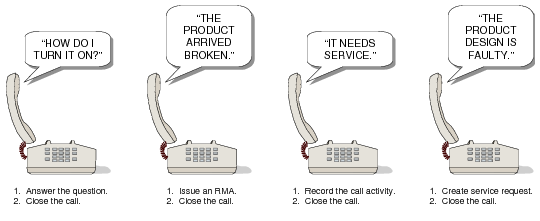
Call Life Cycles, four types of calls are routed to separate operations. In actual practice, a single call might include all these scenarios.
Call Life Cycles
Questions
For simple calls, the support engineer answers the caller’s question and closes the call. Usually the service organization wants to track these inquiries. For example, a support department can create a database of frequently asked questions and use it for training and quick resolution of calls on the front line. The same database often provides useful feedback to other departments.
Note: To filter out calls that do not require service activity, you may want to design a pending call system. Pending calls are discussed in
Using Pending Calls.
RMAs
Handle simple replacement calls that do not require an on-site engineer by issuing an RMA. See
Return Material Authorizations for details.
Call Activity Recording
Calls regarding product failures may require a visit by a service engineer. Replacement items may be needed, items may need to be returned to the factory for repair, or an entire system may need to be shipped back and replaced. Preventive maintenance and installation calls are two other types of calls that require the intervention of an engineer. Information from the call is used to resolve billing issues associated with the service activity.
Service Requests
Recurring problems reported by calls can result in the creation of a service request. You can use service requests internally to track problems that may require product design changes. See
Service Requests for details.