GL Audit Detail Delete/Archive
Use GL Audit Detail Delete/Archive (36.23.1) to delete/archive audit detail information. Unlike other delete/archive programs, this program does not delete each record specified. Instead, for each unique combination of user ID, table, and field, it keeps the latest record and deletes/archives the rest.
To delete and/or archive tables:
1 Back up your database and .df files.
1 To safeguard against data archived from a previous product version that has different schema, back up the current database definitions (.df) file with each archive/delete run. This lets you reconstruct a corresponding database for data retrieval.
2 Verify record selection.
Run the delete/archive program without deleting or archiving records. This generates a report showing selected records. Review the report and if records selected for deletion are correct, proceed with the actual archive/delete.
3 Run appropriate historical reports such as Invoice History Delete/Archive (7.13.23).
4 Determine selection criteria for the records being deleted, and run the delete/archive program, selecting both Delete and Archive.
The program creates a xxyymmdd.hst file in the default directory where xx is the record identifier, such as iv for invoices and yymmdd is the archive date.
5 Verify deletion of records from the database.
6 Verify the contents of the .hst file using the appropriate operating system command.
7 Back up the .hst file to storage media and delete from system.
The delete/archive program does not reduce database size. To reduce database size, use a dump/load program.
GL Transaction Delete/Archive
General ledger transactions created in operational functions such as purchasing, inventory control, manufacturing, and fixed assets are stored in the unposted transaction table until they are posted. Review unposted transactions using Unposted Transaction Inquiry (25.13.13).
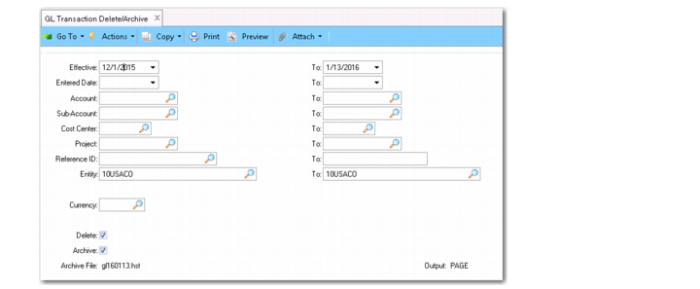
Use GL Transaction Delete/Archive (36.23.2) to delete and archive unposted transactions created in modules other than General Ledger.
Note: GL transactions are stored in the unposted transaction table until they are posted. Unposted transactions can be reviewed using Unposted Transaction Inquiry.
Use GL Transaction Delete/Archive in two specific situations:
• You are not using QAD Financials.
• You implemented other modules prior to implementing Financials. Before implementing General Ledger, delete the GL transactions in the unposted transaction table since these are already reflected in the beginning balances you enter.
Important: For a standard implementation, GL Transaction Delete/Archive is used only during early stages of implementation. After transactions of a particular type (PO, IC, WO, or FA) have been posted to the general ledger, no further transactions of that type can be deleted or reloaded.
You should run this function twice. First, run it with Delete set to No and review the report. Then, run it with Delete set to Yes.
When you set Delete to Yes, GL transactions that satisfy the selection criteria are deleted from the database. If you set Archive to Yes, deleted data are copied to an ASCII file that can be reloaded using Archive File Reload. Otherwise, deleted data cannot be recovered.
When Archive is Yes, selected data is stored in a file named glYYMMDD.hst, where gl is the record type and YYMMDD is the file creation date. If this file does not exist in the system, it is created. If it does exist because you already ran delete/archive the same day, the system adds the additional archived records to the end of the file.
Since the generated file has no internal label or content description, you should keep a record of the file name and contents, in case you need to reload the data. Also, remember that you cannot selectively reload data from archive files. If an archive file contains data for an entire year and you need to access records for one month, you must reload all the data in the file to access the records you need.
Important: Date and time in the stored data are formatted based on the country code associated with the user who archived the data. If a user with a different date and time format reloads the data, load errors and corrupted data can occur.
To avoid these problems, use the same settings when archiving and reloading the data. Before loading data, use User Maintenance to temporarily change your country code to match that of the user who archived the data.
You should define menu security for this program.
GL Transaction Delete/Archive (36.23.2)