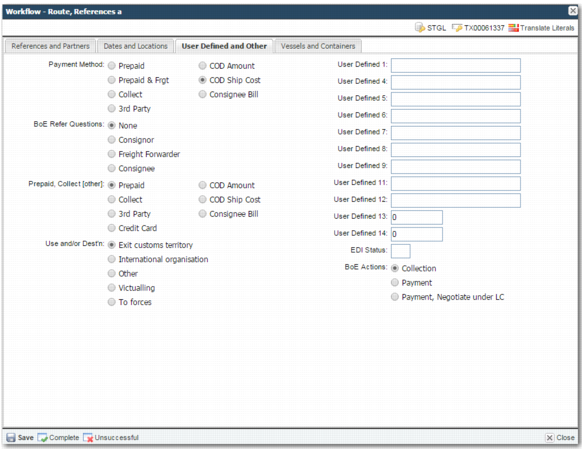
Option | Explanation |
Prepaid | The shipper pays for the freight. |
Prepaid & Frgt | Prepaid and add freight. The shipper pays the carrier for the freight, but the charges are marked as billable. The details of the charges can be sent to the ERP system and appear on the invoice. |
Collect | The consignee is billed for the freight. The carrier bills the consignee using the carrier account, if available, and the consignee address. You must enter a carrier account number. |
3rd Party | A third party pays the freight costs. Provide a carrier account number for this third party; the carrier account number field is optional. Some carriers also require the third party address. You can enter an address on the rating screen. |
COD Amount | Collect on Delivery Amount. The shipper pays for the freight. Before handing the goods to the receiver, the carrier collects a payment from the receiver of the goods. The receiver payment relates to the cost of the goods. The carrier forwards the payment from the receiver to the shipper. |
COD Ship Cost | Collect on Delivery Ship Cost. The shipper pays for the freight. Before handing the goods to the receiver, the carrier collects a payment from the receiver of the goods. The receiver payment is for the cost of freight and the cost of the goods. The carrier forwards the receiver payment to the shipper. |
Consignee Bill | The consignee pays the cost of carriage using an account that they hold with the carrier. To charge the cost of carriage to the consignee carrier account, select this option. |
Option | Explanation |
Exit customs territory | The goods are exiting the customs territory of the European Union. |
International organisation | The goods are for supply to an international organization. |
Other | The goods are intended for another purpose or destination. |
Victualling | The goods are provisions for the shipping journey. |
To forces | The goods are intended for use by military forces in an EU member state. |
Options | Explanation |
Collection | The Bill of Exchange is drawn on when the carrier delivers the goods to the consignor. |
Payment | The Bill of Exchange is drawn on when the consignor initially orders and pays for the goods. |
Payment, Negotiate under LC | The Bill of Exchange is drawn on when the consignor initially orders and pays for the goods, and the Bill of Exchange is related to a Letter of Credit. The Letter of Credit is a document that the bank provides, stating the ability of a party to pay a specified amount of money. |