
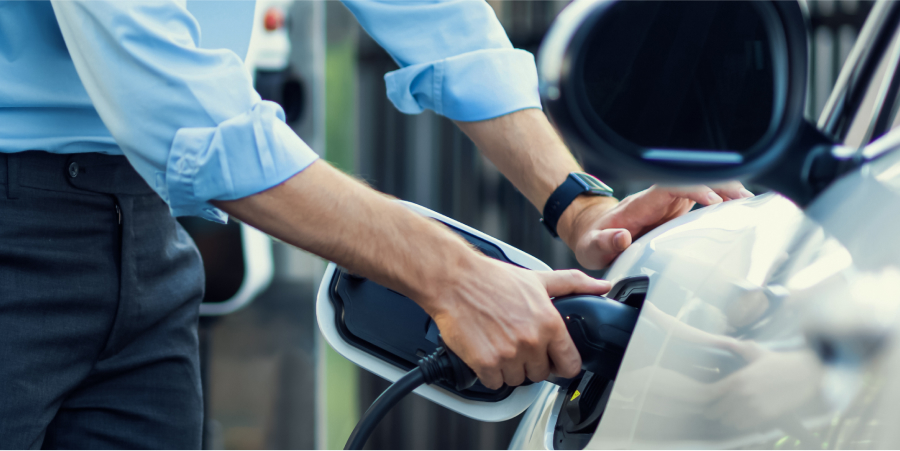
Over the past decade, governments and leading automakers have moved toward electric vehicles as a key green technology to reduce oil use and combat climate change. In 2021, major automakers—including Ford, Mercedes-Benz, General Motors, and Volvo—pledged to work toward phasing out new gasoline and diesel-powered vehicle sales by 2040 worldwide.
The absence of tailpipe emissions might seem like a no-brainer when considering the energy it costs to charge and produce the batteries. But as battery electric vehicles (BEVs) become mainstream, they’ve faced a pertinent question: Are they cleaner than traditional internal combustion engines (ICE)?
In this article, we’ll dig into the differences between the ICE and BEV to settle the tank vs. battery debate.
Understanding the Differences Between BEVs and the ICE
As the global market shifts to meet new fuel efficiency standards, leading automakers have focused on BEVs as a greener alternative to ICE. Electric vehicles are generally far more fuel efficient than their counterparts, mainly because electric motors are more efficient than ICEs.
That said, the environmental friendliness of BEVs depends on several factors, from the electricity used to charge the batteries to the manufacturing process of the batteries themselves. To measure new battery technology versus ICEs, let’s dive deep into each process stage.
The Production Process
Most skeptics challenging the cleanliness of BEVs tend to point to the battery production process first. This is a logical space to start since the production of batteries is easily the dirtiest part of the process. Although EV’s full-life emissions are lower than ICE-powered vehicles, EV manufacturing does have a dark side.
With the dramatic shift toward BEVs, the need to accelerate battery cell production and advanced battery technology is ramping up globally. Manufacturers of electric vehicles are searching for more sources of minerals and materials for lithium-ion batteries, with competition between different supply chain controllers at an all-time high.
Producing high-grade automotive lithium-ion batteries still emits significant amounts of carbon and requires the extraction of natural resources. In a scenario outlined by the International Energy Agency that meets the Paris Agreement goals, clean energy technologies’ share of total demand will increase significantly over the next two decades to over 40% for copper and rare earth elements, 60-70% for nickel and cobalt, and almost 90% for lithium.
Research shows that an EV needs approximately 485 lbs. of minerals like copper, nickel, cobalt, and lithium, which is 6x more than a traditional ICE-powered vehicle. That said, a large portion of the pollution created by the battery manufacturing process is explicitly created by China, which has opportunities to improve its carbon footprint significantly.
Creating Greener Battery Production Processes
Chinese EV battery manufacturers emit 60% more carbon dioxide to produce a BEV battery than an ICE. However, if China adopted American or European manufacturing techniques, it could reduce its carbon emissions by up to 66%, making the battery production process cleaner than the ICE’s. Ultimately, improvements in infrastructure, greener energy sourcing, and more efficient manufacturing techniques can all drastically drive greenhouse gasses down, making BEV an increasingly greener choice.
In addition to greener manufacturing techniques, recycling EV batteries is often considered a means to reduce the emissions associated with manufacturing EVs by cutting the requirements for primary supply. Recycling considers both conventional sources and emerging waste streams, such as spent batteries from electric vehicles. However, with the global marketplace transition to EVs and the growing need for batteries, battery recycling is only a proverbial drop in the manufacturing bucket.
Pump vs. Plug
Whether you own a traditional ICE vehicle or a battery-powered electric vehicle, you’ll still need to refuel it with either gas or electricity—and neither is free of carbon emissions. Over the past decade, plug-in hybrid electric vehicles (PHEVs) and BEVs have become popular for their convenience and greener profiles. But between fueling and charging, what’s the cleaner option?
To start, let’s examine the efficiency of each vehicle type: How long can the vehicle run on a single charge or tank fill-up? According to the Environmental Protection Agency, one gallon of gasoline equals 33.705 kWh of energy, allowing us to compare ICE and BEV efficiency using a miles-per-gallon equivalent (MPGe).
When using MPGe, electric vehicles are three to five times more efficient than their ICE counterparts. For example, the Chevy Bolt can achieve 3.4 times more miles on a single charge than the Honda Civic can perform on a single tank of gas. What’s more, this difference is further exacerbated in larger vehicles. The Tesla Model X, a midsize SUV, achieves 4.4 times the efficiency of the BMW X5. At the same time, the Tesla Model 3 midsize sedan achieves 5.2 more MPGe than the comparable Ford Fusion.

The energy differences between BEVs and traditional vehicles don’t stop there. The BEV also wins the eco-friendly debate with more miles to charge. And when we look at where that energy comes from—and the carbon produced to generate it—BEVs still emerge as the cleaner option. Even if the electric grid that charges BEVs were 100% carbon-based, it’d still have a significantly lower carbon footprint than that of a midsize Sedan with an ICE. However, finding a local grid that still relies solely on coal would be hard to find.
So, how exactly does pumping versus plugging fuel vehicles work? In ICE vehicles, the fuel is ignited, and the gas pushes pistons to generate motion. However, only about 12 percent to 30 percent of the energy in gasoline is used to move a vehicle, while most energy is lost as heat.
Meanwhile, BEVs have electric motors, which consume almost all the energy in electricity to generate movement. Unlike ICE-powered vehicles, BEVs also have “regenerative braking,” where the vehicle’s brakes convert kinetic energy into electricity stored in the battery. Electric cars are significantly more efficient than traditional motors, with over 77% of the energy in electricity converted into movement with regenerative braking.
The Shift Toward Cleaner Energy Generation
In the United States, the use of coal has already significantly dropped, with experts predicting an additional 7.7 percent decrease in the generation mix over the next four years. As a greener alternative to coal, leading energy companies are shifting to natural gas to power the grid.
2018 natural gas accounted for 35 percent of the U.S. energy mix. Renewable energies are also increasing in use, with hydro, wind, and solar power accounting for 16 percent of the total energy generation and growing at nine percent per year. As the shift toward cleaner energy generation becomes more prominent, the BEV—which already has a much smaller carbon footprint—will continue improving its efficiency rating.
Charging Infrastructure Is Growing Rapidly
Of course, refueling electric vehicles comes with a catch: charging infrastructure for BEVs can be spotty, depending on location. While Tesla has installed an extensive network of over 1,000 Supercharger locations in the United States with over 25,000 charging locations worldwide, they’re only available for Tesla vehicles today.
Fortunately, charging infrastructure is improving. Tesla plans to open its network to other vehicles soon (Ford, GM, and Rivian), drastically increasing the range of BEVs. n addition, in 2021, the U.S. government reported its plans to rapidly install an EV charging network of 500,000 charging stations.
With political motivation, electric vehicle chargers can be installed quickly to improve the range and efficiency of BEVs. In December 2020 alone, China installed 112,000 EV charging stations, exceeding the number of EV charging stations throughout the United States. As a result, China finished 2020 representing nearly two-thirds of all public charging stations installed globally.
Battery Afterlife
Finally, the battery lifespan—and what happens to the battery afterward—are essential factors to consider when assessing the eco-friendliness of BEVs. As mentioned above, recycling lithium-ion batteries is a green option, but battery recycling is currently limited. However, as BEVs grow in popularity, the focus on finding cleaner ways to reuse and recycle them will continue to grow.
After an EV battery finishes its typical 17-year lifespan, a lifecycle comparable with traditional ICE vehicles, most batteries will still obtain a sufficient percentage that could make them useful for storing energy in the grid. This second battery life could add up to 10 more years to its original lifespan, significantly reducing its lifetime carbon footprint.
According to a recent study by Ford, light-duty electric vehicles have approximately 64 percent lower cradle-to-grave lifecycle greenhouse gas emissions than ICE vehicles across the United States. Researchers also found that switching from ICE to battery results in a more significant reduction of emissions as the vehicle size increases due to the greater fuel consumption of larger vehicles, as mentioned above.
How Quickly Do Batteries Degrade?
Batteries in EVs typically degrade due to temperature, cycles, and time. Storage and operating temperatures drastically impact the lifecycle of batteries; in general, warmer climates negatively affect the lifespan of the EV battery. As the battery undergoes charge cycles, it slowly loses its maximum potential. However, not using or charging an EV battery doesn’t mean it’ll last forever, as lithium-ion batteries are also subject to calendar degradation over time.
Unlike lithium-ion batteries in smartphones and laptops, EV batteries leverage complex battery management systems (BMS) that regulate how batteries are charged and discharged to extend their lifespan. The U.S. government mandates EV manufacturers to warranty batteries for eight years or 100,000 miles, while California extends that warranty to 10 years or 150,000 miles.
As batteries reach the end of their lifecycle, recycling components of the battery could also help reduce its environmental impact. Material sourcing currently accounts for roughly 50 percent of greenhouse gas emissions during the manufacturing process of batteries. Finding efficient ways to recycle these materials, such as aluminum, nickel, and cobalt, will help reduce the need to extract more natural resources—making the production process cleaner.
Technology Forecast: The Future of BEVs
Considering that BEV technology development is rapidly advancing and public charging infrastructure will undergo improvements in the near future, many of the factors presented here are likely to change over time. Electrification is reducing and eliminating many parts used in traditional ICEs, with lower battery costs accelerating the market transition to BEVs.
If lithium-ion batteries’ cost per kWh and environmental impacts decline, this would drastically alter the overall picture for BEVs. Over time, the U.S. energy mix for electricity generation will continue to shift from conventional sources to renewable energy and increase natural gas use to achieve emissions targets.
Since the launch of BEVs in the United States in 2010, the cost of manufacturing battery packs has decreased significantly. Experts predicted that the cost per kWh of lithium-ion batteries would be slashed by 2020—dropping to $120 per kWh. However, as announced in September 2020, Tesla’s new “4680” battery pack has dropped battery costs as low as $57 per kW/h. At the same time, the density of batteries will continue to improve, and lighter batteries will provide a greater driving range for BEVs.
Based on future technology trends and emissions standards, it’s likely that manufacturers of BEVs will take advantage of these developments to increase the battery pack size and extend the BEV range, as seen with the Chevrolet Bolt. These changes will further increase the environmental-friendly profile of BEVs, while traditional vehicles will cost increasingly more to produce according to stringent Corporate Average Fuel Economy (CAFE) standards.
Winning in a BEV World
While electric vehicle technology and battery efficiency continue to improve year after year, there have been far fewer advances for ICEs. As BEVs become auto manufacturers’ primary focus and emissions standards are strengthened, ICEs—and even plug-in hybrid vehicles—may be phased out.
The mainstream adoption of BEVs won’t happen overnight. Still, it is coming at a rapid speed, and the survival and growth of traditional auto suppliers will depend on how they can plan for the future, which requires expert knowledge to navigate.




As the global conversation around sustainable transportation gains momentum, whether battery electric vehicles (BEVs) are truly more eco-friendly than their gas-powered counterparts has become a topic of fervent debate. In this thought-provoking blog post, the team at QAD delves into the heart of this matter, aiming to provide clarity amidst the sea of information.