The healthcare industry is renowned for innovation. Medical device firms and pharmaceutical firms spend billions of dollars on research and development. They are constantly faced with new health challenges and expiring patents, so I think it is safe to say they are learning organizations. The byproduct of billion-dollar R&D budgets, is life-saving medical treatments for the rich or well-insured. Unfortunately for those needy patients that are not insured, those innovations are mostly out of reach. There is currently a big gap between the innovations in the medical industry and the delivery to many patients.
How can we create a harmony between innovation and marginalized populations? Through disruption, of course. The democratization of healthcare is about serving the underserved. Diffusing innovations far enough to improve the day-to-day life of everyone that needs the help. We saw in my last article how Modern Healthcare in Chicago explores with the top executives from Kroger Health and Walmart health, the moral responsibility and the practical opportunities associated with this underserved market and how better solutions from disruptions in the local pharmaceutical marketplace can improve healthcare and positively impact the medical costs that society bears.
Let’s look at a specific example in this article – the diabetic conundrum.
A significant population in the US uses the hospital emergency rooms as their primary care physician. This population is typically uninsured or underinsured and only seek medical attention when they are in an emergency situation. Complications from Diabetes are one of these types of emergencies.
Our youngest daughter is a type 1 diabetic, and I can attest to the enormous expense associated with keeping her healthy. Thanks to our first-class insurance, she has the latest medical devices that seamlessly communicate with each other to provide her with an artificial pancreas. A Continuous Glucose Monitor (CGM) checks her glucose levels, and the results are transmitted to her insulin pump which automatically delivers micro-insulin doses to her day and night. As a result of the coordination of these remarkable innovations, the last time she went to her endocrinologist her A1C (a blood test that measures your average blood sugar level over the past three months) was the healthiest (lowest) it has ever been. This contrasts with the day we discovered she had diabetes when she was 9 years old and her A1C was in the 700s. That A1C level is fatal if untreated. She was admitted to the hospital for 14 days with at least 3 of those days in ICU.
Diabetic Emergencies
Our daughter’s diabetic emergency is similar to that of uninsured diabetics. If diabetics don’t have an endocrinologist or the latest CGM/insulin pump “artificial pancreas”, or affordable insulin, they suffer. High glucose numbers mean circulation issues that could result in amputation, severe ketosis and/or diabetic coma that if left untreated could kill them. So, when the uninsured or underinsured experience these complications, they go to the emergency room. The trauma trained specialists stabilize the patients, maybe send them home with a few supplies and then hope the patient finds a doctor or clinic that can provide ongoing care that keeps them out of the emergency room.
This is where Kroger and Walmart are working to provide a bridge for underserved patients. They are investing in technology and partnerships that help guide these patients to a local store with a healthcare clinic that can provide low-cost supplies and medical care and coordination with local hospitals that can help keep marginalized patients out of the emergency room. As these grocery and discount store clinics provide life saving insulin and supplies to marginalized customers, that revenue will fuel the business. They will start to improve their business models and expand their coverage. They will become a natural place for hospitals to send ANY patient for low cost drugs, medical devices and healthcare providers. This disintermediation will result in loyal local pharmacy customers diverted to Kroger and Walmart for prescriptions. Another blow.
Disruption’s 800 Pound Gorilla
Now, let’s talk about another disruption from a famous disruptor, Mark Cuban. Mr. Cuban has been disrupting business models for decades, so he knows the drill and has decided to take on prescription drugs. His business CostPlus Drug Company promises to bring very affordable drugs to needy patients both insured and uninsured.
For Diabetics, CostPlus is working on a low-cost insulin solution using Lispro, the generic version of Humalog (the insulin our daughter uses). They currently have a test program in place that offers Lispro for $170 for a 90-day supply which works out to approximately $14.00/10ml vial. Compare that to a local pharmacy price of $30/vial with a GoodRx coupon.
And while insulin is only available in a test program right now, let’s look at what CostPlus Drug Company means for my mom who is a loyal local pharmacy customer.
My mom has dementia, as I have discussed in previous articles. She is 84 and in good physical health but she has trouble sleeping, has seasonal allergies and in the last couple years some trouble with her thyroid. She takes several medicines daily. Here is what Mark Cuban’s new disruption means to my mom for a 90-day supply of medicine.
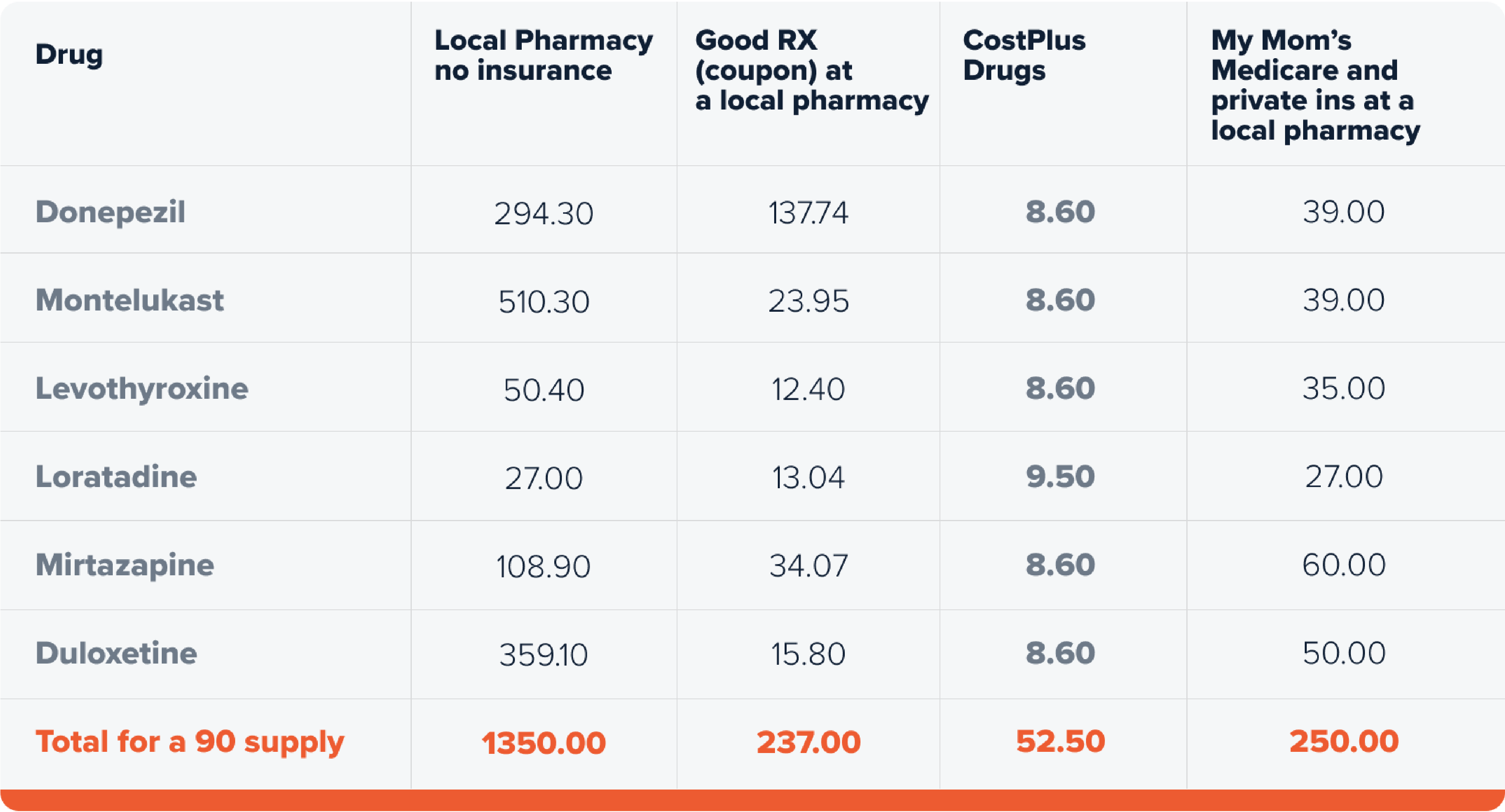
Wow! The first three options are available for anyone whether insured or uninsured, the last is based on Medicare and Medicare part B with private insurance. As soon as I finished this table, I signed my mom up for prescriptions from The CostPlus Drug Company. Even with two insurance policies, my mom will save almost $200.00 every ninety days! Imagine what this would mean to someone without insurance, without a job, without a retirement pension, with kids to feed? Mark Cuban is committed to providing affordable medicine for EVERYONE. And even though my mom is not his target market, it is now the best deal for her too. CostPlus probably started out with less medicines available but as people signed up and revenues (even as small as they might have been) grew, they were able to make more deals and now they stock all the medicine she takes.
As you would expect from Mark Cuban. CostPlus has an easy sign-up process. They need an email and a phone number. They have a one-page sheet that you fill out and send to your doctor to get your prescriptions transferred to CostPlus. They have an e-delivery system as well. You can give your doctor the phone number and have your prescriptions transferred today. The medicine is delivered to your door. One challenge I can see for CostPlus Drug Company is urgent medication. If you have a sinus infection or a poison ivy reaction, you can’t wait days for a prescription.
But other than that we have VERY affordable, easy solutions for many prescription drugs, convenient one-stop shopping at mega discount stores or affordable grocery stores with clinics and pharmacies. What other reason do we have for going to a local pharmacy? A passport photo?
Technology Assisted Diffusion
The challenge for discount stores like Walmart and grocery stores like Kroger is managing the patients in an effective way as the volume of visits increases. They are now part hospital, part pharmacy, along with their grocery store/discount store day job. There is a lot that could go wrong. I started to think about technology solutions to assist in the transition to democratized healthcare.
- A call center with sophisticated CRM software that routes clinical questions to nurse practitioners that can provide telehealth (even if they walked into a store). This way patients don’t stay on hold waiting for multitasking pharmacists or nurse practitioners. The CRM software can keep important information in profiles for patients that link the call center to the geographically convenient in-store clinic and local hospital, so patients can be directed to conveniently located one-on-one care, and for more serious issues, maybe to the hospital.
- Device assisted diagnostic equipment. Every pharmacy I’ve walked into for years has the blood pressure cuff at the ready, but there are loads of sophisticated devices that can analyze a drop of blood or a retina scan. I have an app on my phone that uses the camera and flash to diagnose stress and irregular heart rates from Afib. These devices can provide more accurate assessments for a busy nurse practitioner in a clinic, improving the quality and speed of care.
- Partnerships between hospital emergency rooms and local stores/clinics for follow up care for uninsured or underinsured patients. Thus, providing an informed hand off to a convenient and low-priced provider. This step could reduce expensive emergency room trips by developing practitioner relationships that encourage regular visits and consistent care.
Advice for Vendors to Local Pharmacies
- Cost Plus Drug Company is a real threat by an experienced disruptor. DO NOT ignore this. Mark Cuban’s value proposition is compelling. It already makes sense for users that would normally be in a laggard category (my mom). This means that his company could easily diffuse in an R shaped curve (straight up) like radios and iPhones. I would imagine the only thing holding back the deluge is advertising which he may be resisting because of supply? Find a way to work with him.
- If Mark is successful and demand shifts in a significant way to his home delivery model, swarms of local pharmacy convenience shoppers will no longer be grabbing an expensive roll of paper towels or a pack of batteries or a bottle of dawn dishwashing liquid. Prepare for this shift in demand.
Local pharmacies will not disappear. In every disruption, there is always a traditional supplier that remains. That winner is the supplier that can exist at the lowest margins, that can offer the local pharmacy a product that can compete with Walmart and Amazon and Kroger. Like the printing plant that is still operating in the wake of the digital revolution printing out the newspaper that the diehards won’t give up.