Stop Expecting an EV Tidal Wave
In a recent QAD blog, Paul Eichenberg of automotive consulting firm Paul Eichenberg Strategic Consulting discusses recent news about the electrical vehicle forecast for the US market. It looks like the domestic automakers as well as BMW and Hyundai have a promising outlook on EV production in the US. I was thrilled to learn this news!
Four years ago, I bought a Tesla model X. I am an Extension Master Gardener in two states, and regularly educated on the impacts of climate change, so I decided to reduce my carbon output by buying an electric car. It was life changing. I no longer think about getting gas because everyday I wake up to a fully charged vehicle, no more oil changes or worries about overheated engines. Let’s just say I learned expensive lessons about car maintenance in college, much to my father’s chagrin. My nifty, innovative Tesla app tells me that I have saved $1,700 on gas this past year, which includes the money I spent to charge at Tesla Superchargers and at home. My car is very quiet which I expected and very fast which was a pleasant surprise. EVs have a fraction of the parts of an ICE vehicle so in four years and 53,000 miles, I have not had a single issue. Thanks to regenerative braking (think golf cart), I have the original brakes too. The technology and convenience of my electric car has made me an advocate for this diffusing technology but I am in the minority. In fact, I am part of the first 2.8% of EV owners in the world.
US Consumer Disruption Denial
I teach business and engineering classes at Wayne State University in Detroit. Often, I ask my students, many of whom work for the Detroit Automotives, what they think of Tesla and their views are negative. They tell me about range anxiety, autonomous driving accidents, and the lack of charging infrastructure, all harbingers of disruption denial or “status quo bias”. No one has anything good to say about the vehicle, but few have actually driven in one. These are typical reactions about a disruption from mainstream consumers. Remember what we thought about digital cameras when they were first introduced?
My Tesla can go from Detroit to Petoskey, about 250 miles, on one charge. Granted, I am pulling into the garage on fumes…um, sparks but I can make it. And while I can go 250 miles on a single charge, if I need to charge, there are several high speed charging stations on the way up north in grocery store parking lots. The navigation system will tell me if I need to stop and exactly where to go to charge. In fact, the self-driving feature is seamlessly tied into the navigation system. It will drive me to the chargers. I have been using it since I test drove the car and its capabilities are stunning. I have used the advanced cruise features of many vehicles including Ford, GM, and Range Rover and none of them get close to Tesla.
When I discuss EVs with other friends, they are bearish on electric vehicles as well. I hear things like; too expensive, unprofitable, limited range and limited infrastructure, the batteries are dangerous, too quiet, very similar to the students. It doesn’t surprise me. This is normal for a disruptive innovation. Mainstream consumers are going to push back. It takes time for diffusion to happen and in a market like the US with so many people dependent on ICE vehicle production whether foreign or domestic. I suspect it will be very slow. Think about it, when we switch to EVs how many jobs will be impacted at ICE manufacturers, suppliers of ICE parts, dealers, etc? All of these practical and emotional elements impact diffusion.
And you might be thinking, wait, the mainstream manufacturers are building EVs, yes they are, but that doesn’t change how the employees and suppliers who design and build the engines, exhaust systems and thousands of other parts that are exclusive to ICE vehicles feel about the change to EVs. It is terrifying for them and their families. It’s not about retraining for a new model, the parts they are responsible for are absent in the EV world. If the employee is not an engine designer, then what are they? This identity issue is part of status quo bias and will impact EV diffusion in markets where ICE vehicle production is significant.
Then, we have to consider Everette Rogers’ “perceived attributes of innovations” for EVs in mainstream markets. How do potential customers perceive the change to EVs?
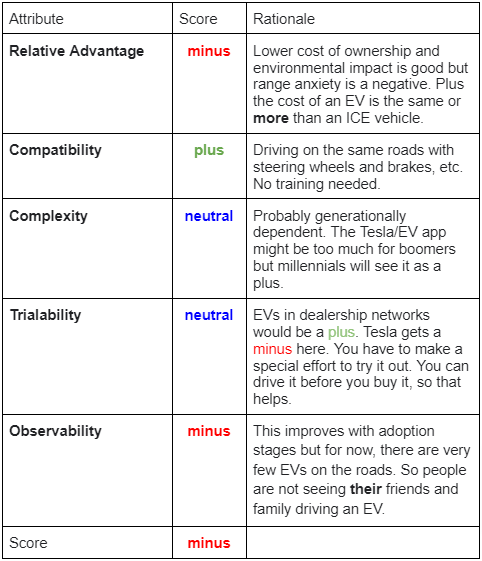
These ratings mean that it’s not compelling to switch to an EV in a mainstream market like the US, so again, the adoption rate is not a surprise. It’s going to be slow but don’t give up!
It was interesting when the mainstream manufacturers suddenly jumped in and with such aggressive forecasts but I was glad to see it. I hope everyone buys an electric vehicle. But expecting US mainstream customers to adopt all those new EVs was unrealistic. US diffusion will be gradual, but even with the bearish US market, I‘m confident that EV disruption is inevitable. And I am delighted to read about the recent US domestic forecast! Build it and they will come? It might be the only way to get the laggards in the US market to migrate to EVs.
Global diffusion is another story entirely. And we will look at that in the next article. For now advice to the mainstream ICE supply chain:
What to Do About EV Disruption?
- Don’t think that because EVs aren’t exploding onto the scenes in the US that they are not an inevitable disruption to the ICE market. Besides, the domestic manufacturers have declared their intention to compete! Get on board, make a plan.
- Start to look for ways to supply materials to EV manufacturers. This will be a challenge since EVs have a fraction of the parts of ICE vehicles but EVs still need seats, windows, steering wheels, radios, climate systems, batteries, brakes and tires etc. Find a way to lower prices, it is going to be critical!
- If you produce an ICE only product, know that it will take many years to migrate from ICE to EV in the US, but start looking for other industries where your parts can be used in other types of products with gas engines. If you have the supply chain and economies of scale to compete in the competitive automotive market, you might have a fantastic new marketplace in a high end engine market. Start to build relationships with new industries while keeping your existing auto manufacturing base. Disruption takes time no matter what the advantages.
- If you are ICE only, make sure you have the best margins and can outlast the other competitors as the market shifts. There will always be an ICE market of some size, make sure you are the last man or woman (in the case of GM) standing.
Stay tuned for my next article on EV acceleration around the globe.