
Small delays in shipping execution rarely stay isolated. Over time, they increase costs, limit throughput, reduce carrier agility, and weaken control over final-mile carrier selection in ways that directly affect service levels.
When Execution Speed Becomes a Business Variable
Shipping performance is rarely lost in a single decision.
It erodes quietly, second by second, transaction by transaction.
For many manufacturers, transportation discussions focus on planning rather than shipping execution. Network design. Carrier strategy. Optimization models. These matter. But they often assume execution is neutral, that once a plan is made, the work simply happens.
In reality, execution speed plays a direct role in cost, capacity, and control. When execution slows, friction accumulates. When execution is fast and consistent, systems stay calm.
The Hidden Cost of “Almost Fast Enough”
Execution delays are rarely dramatic.
They show up as:
- Extra seconds to generate a shipping label
- Manual steps to book or rebook a carrier
- Lag when switching service levels or providers
- Slow reaction when a carrier misses a commitment
Individually, these moments feel insignificant. At scale, they define throughput.
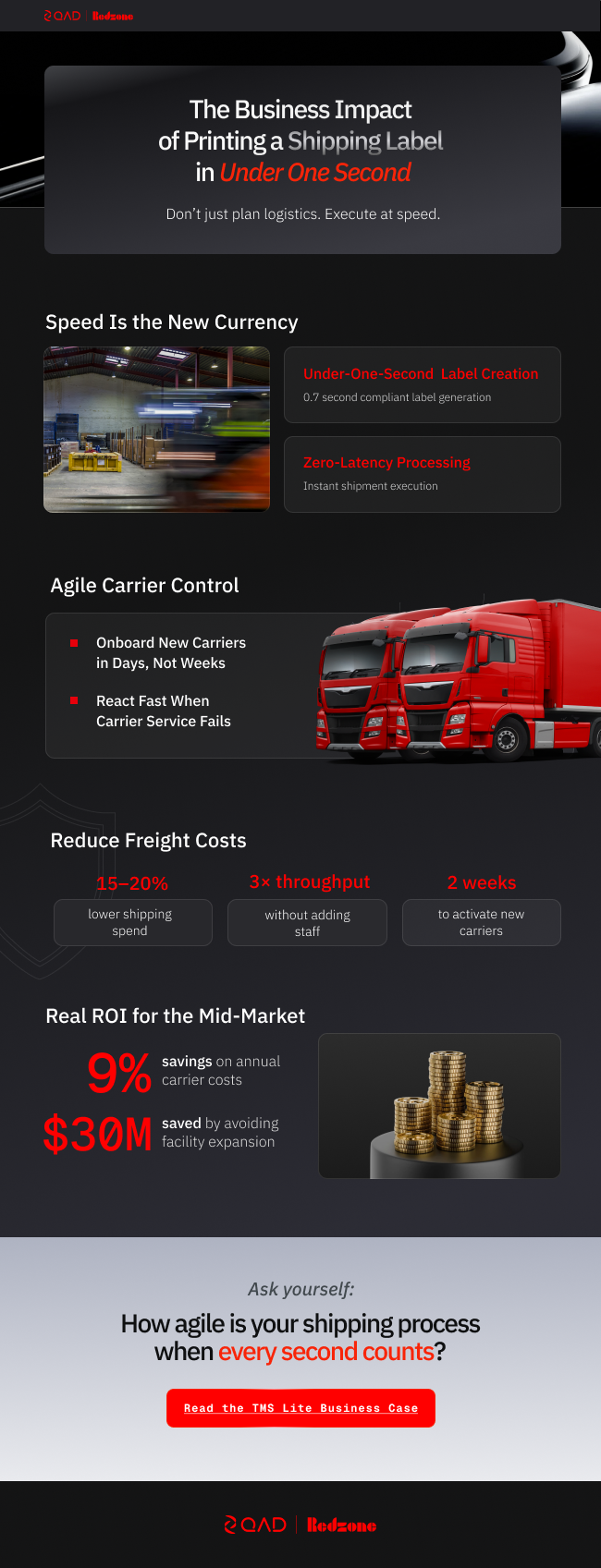
Under-one-second label creation, measured at approximately 0.7 seconds, removes latency at the point where shipments are physically released without adding system complexity. This is not about speed for its own sake. It is about eliminating execution drag from the most repeated action in shipping.
Throughput, Not Just Efficiency
When execution is slow, throughput becomes the constraint.
Teams compensate with workarounds, extra labor, extended dock hours.
When execution is fast, throughput scales without disruption.
Operations running near-instant execution can handle significantly higher shipment volumes, often up to three times throughput, without adding staff. The outcome is driven by removing delay from execution itself.
Carrier Agility Depends on Execution Speed
Carrier agility is often framed as a contracting problem. In practice, it is an execution problem.
When onboarding a new carrier takes weeks, teams hesitate to adapt. When switching carriers mid-day is slow or manual, service failures linger.
Execution-first environments reduce that friction. Carrier onboarding measured in days rather than weeks, and faster response when carrier service fails, change how teams operate under pressure.
Where the Business Case Actually Lives
The business impact of execution speed shows up in outcomes that finance and operations both recognize:
- Lower shipping spend, often in the range of 15 to 20 percent
- Reduced annual carrier costs
- Avoided capital expansion while improving control over the customer delivery experience
These outcomes reflect what happens when execution stops being the bottleneck.
Rethinking TMS Decisions Through an Execution Lens
When organizations evaluate TMS options after outgrowing spreadsheets, feature breadth often dominates the discussion. More scenarios. More optimization. More dashboards.
Execution raises different questions:
- How fast can shipments actually be processed?
- Where does latency enter the process today?
- What happens when volume spikes or a carrier fails?
- How much effort is spent managing execution rather than improving it?
The answers to these questions shape cost, service, and control long after implementation decisions are made.
A Calm System is a Fast System
In well-run shipping operations, nothing escalates.
Labels generate without delay.
Carriers switch without drama.
Throughput increases without overtime.
That calm is designed into execution.
For teams reassessing transportation systems, execution speed is not a technical detail. It is a business lever.
Explore the execution-first business case for TMS decisions.
Download the TMS Lite Business Case eBook