Do you ever wonder how some companies can leverage technology into breakthrough innovation and improved revenues while others languish with one failed attempt after another, stuck in the muck of aging technology?
Is it a cultural issue? Or generational?
Generationally speaking, my son Max is a “gamer”. I don’t think it is the best use of time, but don’t get me started on that! A few years ago, he called to tell me he wanted to start streaming. What?! Don’t you have a stats class? What is streaming? He went on to tell me about how a group of gamers get together to play a game and broadcast the game so others can watch. The gamers laugh and make fun of each other, yell and scream about the events in the game and people come in droves to follow along and watch. While I was dismayed by the amount of time he would not be studying, I quickly became interested in this endeavor after he told me what he needed to begin streaming online.
Technology and Millennials
Max needed to learn creative software tools and he needed an open-source streaming package to start his streaming journey. He also needed to learn how to adjust audio preferences using YouTube. Prior to this discovery, I couldn’t have cared less about gaming, but I was very interested in my “not so interested in school” son learning major software packages! I gladly paid for the SaaS license for Adobe and OBS was free to use. Within a couple weeks, he was up and running and so proud of himself. I was proud of him too. And it really made me think about the ease, low cost and sophistication of today’s applications. What can’t you do?
My son is part of a generation that was raised with technology. Like other kids his age, he had a cell phone before he was 10. He had gaming consoles, laptops and desktop computers. He has amazing online playlists and on and on. He totally believes that any problem can be solved with technology. He would just need to find the right app.
I can just imagine Max as an executive at a company. He would be sitting in a meeting with a CIO who is telling him that he could absolutely solve the company’s problem; it will just take millions of dollars and years to develop. Max would laugh, pull out his phone and download an app, while texting one of his wizard gamer buddies to come in and take over for the CIO.
Now, let’s not get the wrong idea. I’m not suggesting that you run your company with free phone apps. But as an organization, it’s important to start thinking about new ways to solve problems. When you interview candidates for IT roles, what questions do you ask? How about, “Tell me about the last time you solved a business problem for less than $50?”
What about culture? Do you get more from technology if you believe it can transform your company? The answer: Yes, you do.
Culture: The Role of Technology in Organizations
My research began with a 2018 Information and Management article, which looked at how the role of technology impacts an organization’s financial results. In their work they looked at industries where technology was either automating, empowering or transforming, and the subsequent impact on business results. If you expect more from technology, do you get better results? In this case, they answered yes, and we followed up in 2021 to look at similar parameters.
Our study extended work previously done by looking specifically at Software-as-a-Service (SaaS) technology. We wanted to understand whether organizations that implemented SaaS and required or expected more from technology got better financial results and higher levels of productivity. In our study, the role of technology was a significant mediator between the amount of SaaS implemented and organizational results.
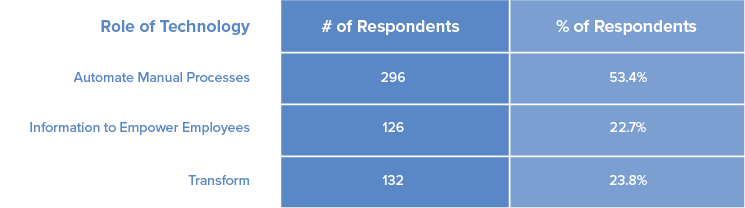
In our survey of 554 senior IT managers and CIOs, using the previous research, we asked how respondents classified technology within their organization. This helped us to understand the importance of technology within the organization; is it critical or nice to have? The survey question asked;
What is the role that best describes how information technology is viewed in your organization?
The response choices were:
- Information technology helps us to automate by replacing human labor with automated business processes.
- Information technology helps us with information to empower management and employees.
- Information technology fundamentally transforms our business and industry processes and relationships.
The biggest differences in results were between the Automate and Transform categories. Let’s take a deeper look:
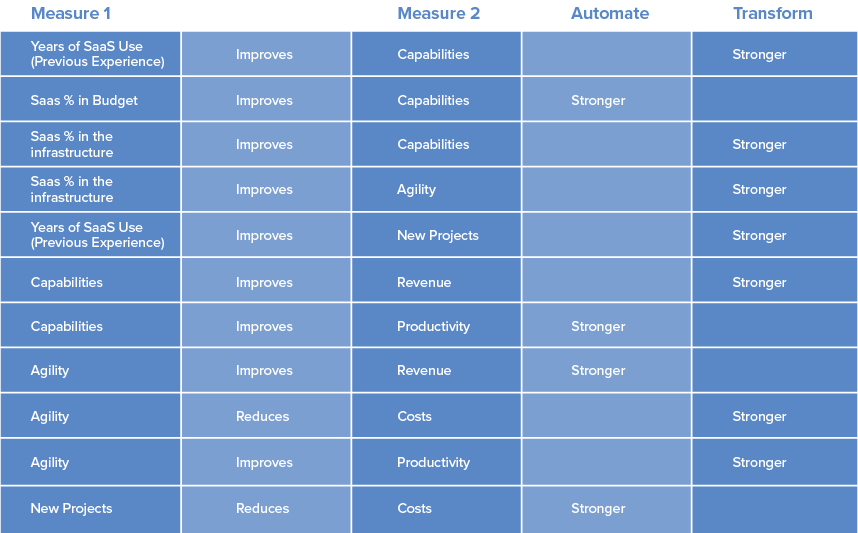
Why do we think that the Transform category gets better results with SaaS? In a nutshell, because today’s businesses can’t survive without technological capability. They believe it can and should solve their problems and so they aggressively pursue a digital transformation.
But what if you’re saying, I’m not a “transform” business…yet, what kind of results can I expect? Interesting question, but don’t despair! Most of the businesses in the survey identified themselves using the Automate category. Whacky, huh? I thought so. The survey went out in early 2021, and by that time I expected that most businesses would say that technology fundamentally transforms us but no, that was not the case. Research is “like a box of chocolates, you never know what you’re going to get!”
Across the board, regardless of the role of technology, our research indicated that the best way to get best-of-breed functionality is through Software as a Service. How can we say that? That answer is a little longer.
The Importance of SaaS in Business
In previous literature, researchers examined the differences between firms that did in-house development and those that did not have the internal resources for bespoke development and so used off-the-shelf technology, like the enterprise software offered by QAD. They defined the off-the-shelf guys as the control group. In studies starting in 2014, they found that in many cases the control group outperformed the in-house developers. This was very controversial at the time as it raised the question of whether custom development had passed its prime. Applications like ERP and the web were mentioned, but the definitions were too vague to give anyone a clear direction, other than, you don’t need an army of in-house developers to succeed in your market.
Having spent 30 years in the technology industry (often up against the bespoke development guys), this article was like finding the Holy Grail. Not that technology salespeople can run around touting academic articles, especially since CIOs are not exactly the target audience for MIS Quarterly or Information and Management, but it was what I had suspected all along! The articles talked about all the things I had experienced through empirical research and throughout my time in the technology industry. Custom development took too long, it created rigidity within organizations because of all the integration points, hindering innovation and agility. And even when off-the-shelf applications were used but then heavily customized, the same rigidity was experienced.
Hallelujah! Finally!
After the 2014 article, the researchers looked toward industry for an explanation of the results. In 2019, they found that organizations whose technology needs were classified as transforming had better financial results when they used homogenous technology rather than in-house development. Again, the reasons were similar. The need for agility and innovation were paramount in businesses that were facing extreme competition and a fluid market, so there was no time for custom development.
The researchers represented that time to market and building a customer base had become critical. Get the product out in front of customers, understand the market, react and respond fast. Again, no time for custom development of back-office applications. The focus was to get an application like ERP or CRM up and running fast so that they could respond quickly and appropriately to customers interested in their products and to get suppliers helping to perfect their own offerings.
What I felt was missing from existing research was; What kind of homogenous technology was being used by these firms?
Previous research was pretty high level when it came to defining the tools that the control group was using. The main point was to say that in-house development no longer had an advantage, and that off-the-shelf technology was helping firms outperform their bespoke development competitors.
So, to extend the existing research, we decided to ask;
Would SaaS implementations improve financial results in firms where technology had different roles?
Across all the Industry Role classifications (Automate, Empower, Transform), SaaS was regarded as instrumental in improving firm results. The chart below outlines the respondents’ level of agreement with the statement: SaaS has helped us increase our overall revenue.
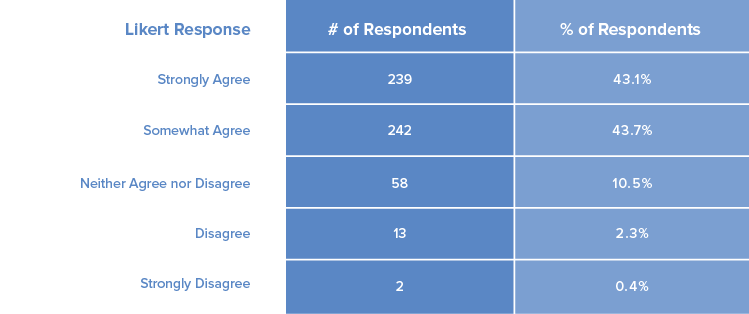
Based on the responses in the chart, SaaS has definitely helped businesses increase overall revenue.
A SaaS First Approach
Since the last article in the previous research was published in 2019, we had to ask ourselves;
Who is not using cloud and SaaS in 2019? Why are firms holding on to in-house development?
In our survey, we divided the responses to the levels of SaaS implemented into quartiles and about 30% of the respondents had less than 50%. So, there is still quite a bit of custom coding or customizing going on. We’ll address why in another blog. Suffice to say that across the board, SaaS is growing and those with higher levels of SaaS, that want transformational results are performing better financially.
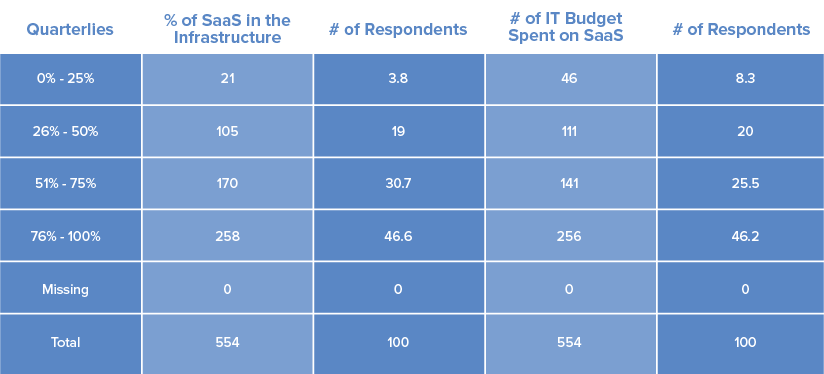
Our research showed that there was a significant difference in profitability between firms that had 51% or more SaaS in their infrastructure. Oh, yeah, the firms with more than 51% had higher profits!