Scheduled Order Management
Scheduled Order Management includes customer and supplier schedules and optional customer sequence schedules and supplier shipping schedules. Trade sales orders are a type of customer schedule you can create with another optional module. This chapter provides a brief overview of the underlying principles of Scheduled Order Management, describes the various schedules, and describes trade sales order creation and processing.
Overview of Scheduled Order ManagementScheduled Order Management is a combination of processes for managing the regular exchange of information among customers and suppliers.
Customer SchedulesCustomer schedules let you process sales orders using a set of scheduled shipment dates and quantities rather than individual sales orders.
Customer Sequence SchedulesThe optional Customer Sequence Schedules module lets you receive and process shorter term, more detailed customer sequence schedules.
Supplier SchedulesSupplier schedules are cumulative, schedule-driven purchase orders with multiple line items from which releases of requirements and due dates are issued.
Supplier Shipping SchedulesThe optional Supplier Shipping Schedules module lets you generate separate supplier planning and shipping schedules.
Trade SalesTrade sales agreement are special agreements between customer, tier-one supplier, and trade sales suppliers.
Overview of Scheduled Order Management
Scheduled Order Management is a combination of processes for managing the regular exchange of information among customers and suppliers. This information is used to coordinate a customer’s manufacturing activities and demand for material with a supplier’s manufacturing activities and shipments of material.
Customer and Supplier Information Exchange
Information is typically transmitted in the form of schedules using electronic data interchange (EDI) to streamline the process. The way information is processed depends on whether you take the point of view of the customer or the supplier:
• As a customer, you transmit schedules to suppliers, balancing demand against what has already been received.
• As a supplier, you process schedules received from customers, balancing demand against what has already been shipped.
For customer schedules, EDI-enabling software is used to pull the releases from a customer’s computer network or an e-mail address the customer has designated. The document is then imported into the system using EDI eCommerce and mapped into a customer schedule maintenance program. Purpose codes within the EDI document determine how it is processed; for example, as an add, append, delete, or test.
For supplier schedules, EDI eCommerce translates the schedule into an EDI format that can be read by the supplier’s system, which is then transmitted as a flat file and imported by the supplier.
Many customers require that an advance ship notice (ASN) be communicated when a shipment is made. The system fulfills this requirement by storing the ASN information from the shipment confirm transaction in the database. EDI eCommerce then converts the ASN information to a format acceptable to the customer’s electronic commerce (EC) subsystem for transmission to the customer. Some customers also require that invoices be sent via EDI; other customers do not require an invoice and pay from the ASN.
Similarly, if you require your suppliers to send an ASN, you import that information using EDI eCommerce. When an ASN is received, it creates a purchase order shipper. When the shipment itself arrives, all you need to do is confirm it and adjust quantities if needed.
See User Guide: QAD EDI eCommerce.
Origins of Scheduled Order Management
Scheduled Order Management has its roots in practices developed by the automotive industry to support just-in-time (JIT) manufacturing. Just-in-time methods ensure that the required quantity of material is delivered from suppliers exactly when it is needed. By having a reliable, precisely coordinated flow of goods from suppliers, a customer can maintain an uninterrupted flow of work, while maintaining minimum levels of inventory.
Companies that use Scheduled Order Management share a common profile:
• High production volume
• Long-term commitments with customers and/or suppliers
• Frequent shipments to customers and/or frequent deliveries from suppliers
• Use of electronic data interchange (EDI)
Scheduled Order Management Today
Although it originated in the automotive industry, principles of Scheduled Order Management are being applied by companies in other industries such as electronics and consumer goods. Historically, schedules in the automotive industry have been based on cumulative accounting. A total schedule quantity was determined for a period—often a year. The effect of each shipment to a customer was calculated based on a cumulative total.
However, today, many business environments use Scheduled Order Management to ship against specific requirements. For example, many original equipment manufacturers (OEMs) in the automotive industry use a schedule releasing method that does not rely on cumulative quantities.
The system fully supports noncumulative accounting requirements for customer schedules. Each scheduled order can be marked as cumulative or noncumulative. While shipments can be referenced by cumulative position, discrete pegging of shipping requirements is also supported.
Scheduled Order Management Flow
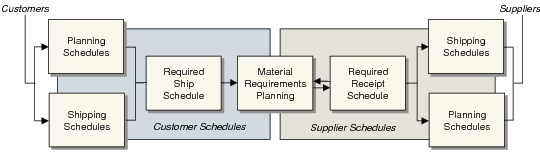
Scheduled Order Management Flow illustrates the basic flow of supply and demand between customers and suppliers.
Scheduled Order Management Flow
Customers send information about the items they need and when they need them as planning or shipping schedules. Based on this information, a required ship schedule is created.
When material requirements planning (MRP) is run, planned work orders and purchase orders are created to fulfill the required ship schedule. The planned purchase orders can be used to create a schedule for your suppliers, communicating your requirements to them.
Characteristics of Schedules
Customer schedules and supplier schedules represent two points of view relative to schedules. The schedules, however, have similar elements.
Shipping Schedules
Shipping schedules are used to coordinate the delivery of materials in the short term, typically one to two weeks. Demand is reported in detail, with quantities specified by date or by date and time. Shipping schedules can be updated frequently to reflect changes in production line schedules.
Planning Schedules
Planning schedules are used for moderate and long-term planning of production, materials, and resources. Demand is summarized and reported in quantities aggregated by day, week, or month. Planning schedules reflect requirements from repetitive schedules, released orders, master schedule orders, and planned orders produced by material requirements planning (MRP).
Schedule Horizons
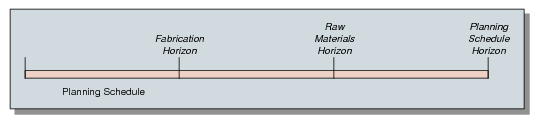
The horizon of a planning schedule should be long enough to allow the supplier to plan materials and resources to support it. It should be longer than the cumulative lead time for the item being supplied.
Schedule Horizons
Within a planning schedule, a customer can also define two other horizons:
• A fabrication horizon authorizes the supplier to proceed with the production of quantities, scheduled for delivery up to a specified date. The level of fabrication is usually below that of a finished product.
• A raw material horizon authorizes the purchase of raw materials to support the production of quantities that are scheduled for delivery up to a specified date.
The end of the planning schedule normally extends beyond both of these horizons.
Schedule Overlap
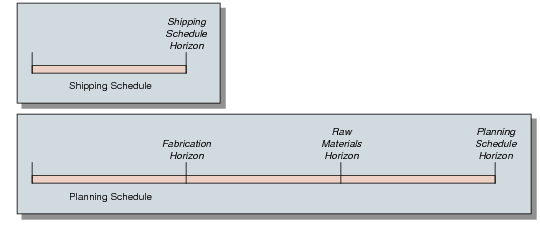
Shipping and planning schedules overlap for the period covered by the shipping schedule. Within this period, the two schedules may not be exactly the same, since they obtain demand from two different sources:
• The shipping schedule from production line schedules
• The planning schedule from repetitive schedules, released orders, master schedule orders, and MRP-planned orders
Schedule Overlaps
The system lets you determine which schedule should take precedence when discrepancies occur.
Updating Schedules
Shipping and planning schedules are only effective when they are accurate and up-to-date. In the automotive industry, new shipping and planning schedules are typically created for each update. Creating separate releases of each schedule ensures that it is easy to distinguish the new from the old. This reduces the potential for confusion and miscommunication.
Schedule Quantities
There are three types of schedule quantities:
• Discrete quantities are like the order quantities on standard purchase or sales orders.
• Cumulative quantities also reflect order quantities, but are a total of one or more discrete quantities. For example, a sales order has an item with an order quantity of 25 for 5 consecutive Mondays. The cumulative quantities for those lines would be 25, 50, 75, 100, and 125.
• Net quantities are similar to the quantity open for purchase and sales order lines. However, they are calculated from discrete quantities and adjusted using the cumulative quantity required less the cumulative quantity received or shipped.