Quality Management
Quality Management supports testing of incoming material, finished products, and inventory; inspection of first articles, processes, and items in-process; and destructive testing.
IntroductionDescribes features and testing methods of the Quality Management module.
Setting Up Quality ManagementOutlines the specification requirements, control programs, procedures, and sampling patterns that must be defined before running the module.
Executing Stand-Alone TestsDefines quality orders and explains how to use them to run stand-alone tests.
Conducting Process InspectionsOutlines the requirements and environments of a process inspection.
Conducting Other TestsDescribes which other tests can be performed with quality orders, including audits, inspections, validation, and destructive testing.
Printing Test ResultsShows how to print test results with Certificate of Analysis Print and what the certificate can be used for.
Introduction
The Quality Management module (19) enables you to test incoming material, finished products, and inventory; inspect first articles, processes, or items in-process; and perform destructive testing. For all but in-process inspection, you manage quality with quality orders: documents that specify what is tested, how, and when. You can define specifications, test procedures, and inventory sampling, and record the results of testing.
Inspection Methods
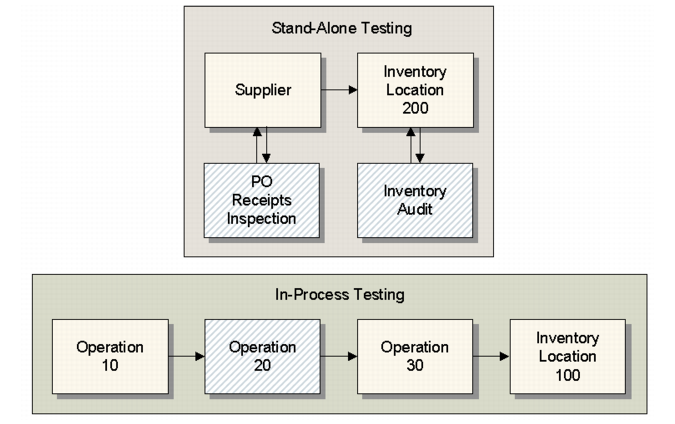
Testing is generally done in one of two ways:
• As a stand-alone task—at purchase receipt or at an inspection station. For this method, you create a quality order to control quantities and dates. The order provides authority to move inventory, perform work, and route items to various locations after the work is completed.
• As an operation within a work order or repetitive schedule routing. In this case, material is moved to a location where the quality tests are performed. Reporting occurs in the Shop Floor Control or Repetitive modules. For work orders without shop floor control reporting, use Test Results Maintenance (19.13) to record results.
Material that is spoiled, damaged, or made obsolete by an engineering change can be quarantined by changing its inventory status code in Inventory Detail Maintenance (3.1.1) to restrict inventory transactions.