Sample Scenario
Consider this illustration of the importance and potential complexity that time zones introduce into service requirements.
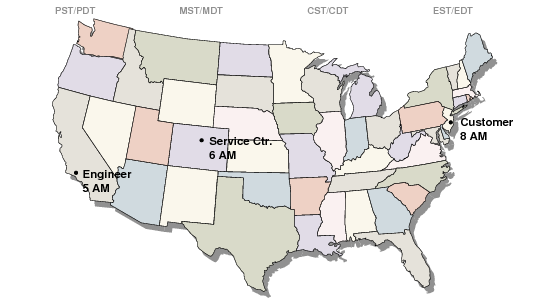
A software support organization has a central service center in Denver. A customer in New Jersey contacts the center in Denver at 8:00 on Monday morning with a critical problem. In Denver, the local time is 6:00 AM.
Managing Multiple Time Zones illustrates the locations in this scenario.
Managing Multiple Time Zones
This customer’s service contract specifies full coverage during normal business hours, defined as 8:00-17:00, Monday through Friday. At other times, the customer pays 50% of the service charges. The contract also specifies that a customer request receives a response within two hours.
So a service call at 8:00 AM (customer time) is fully covered. For the system to find the correct coverage, the time used must be the end user’s.
Based on the response time stipulated in the contract, an engineer should contact the end user by 10:00 AM Monday, New Jersey time. The service center dispatcher assigns the call to an engineer in California, where the time of the call is 5:00 AM Monday. When the engineer reviews the call, he needs to know that he must respond by 7:00 AM his time to meet the contractual obligation.
This is a simple example. In some cases, the system registers date differences as well as time differences.