Contract Design
Of the three common features of contracts—contract types, customers and end users, and items—contract types are applied in the same way to all contracts. Similarly, a contract can be associated with only one customer.
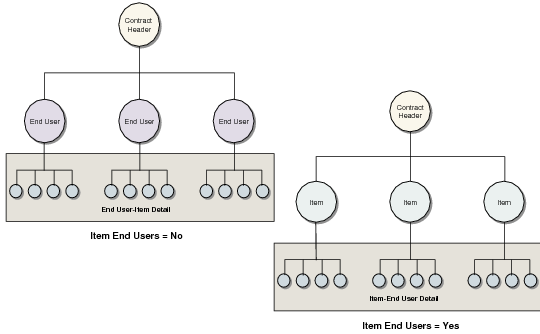
However, the way you view items and end users can vary. As you design a contract, you must make a fundamental choice regarding the relationship between items and end users. Contracts can be viewed in two ways:
• A collection of end users with items requiring coverage
• A collection of items, each with one or more associated end users
Contract Designs illustrates the relationships between components using these two different designs.
Contract Designs
You determine contract design by your choice of Yes or No for the Item End Users field in the contract header.
• Contracts created with Item End Users set to No are referred to as contracts in end-user/item sequence, since you enter end users before you enter items owned by the end users.
• Contracts created with Item End Users set to Yes are referred to as contracts in item/end user sequence, since you enter a default item before you specify end users who own specific instances of the item.
The distinction between these two contract designs affects every aspect of creating and maintaining a contract. This is reflected in the sequence of frames in Contract Maintenance and how data defaults from one contract level to the next. Your choice of items with end users or end users with items also affects:
• Contract billing and how billing information displays on invoices
• How tax defaults for detail lines are found
• How blanket coverage is set up and applied
• How preventive maintenance (PM) schedules are created
To ensure that the distinctions between these two types of contracts are clear, two separate screen flows are provided in this chapter: