Internal Routing Definition
This section describes in detail the different inventory movements and internal routings that are required.
Based upon the example shown in
Inspection Flows, if you have a Receipt internal routing group, a Bulk internal routing group, and an Inspection internal routing group, you would define the receipt movement for the purchase order as follows:
• Internal Routing RCT-PO
• Step 10: Receipt
• Step 20: Bulk
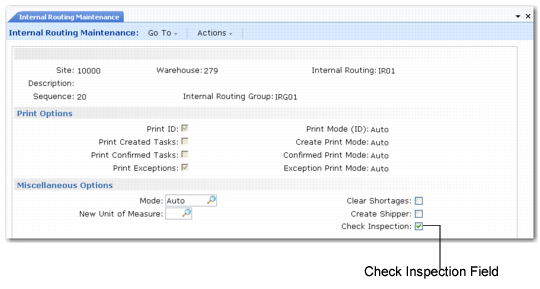
If an inspection is to take place, you must inform the system that it has to check whether a quality algorithm must be started. A field on the internal routing definition of the main receipt movement does this. In this example, on step 20 of the internal routing for RCT-PO, the Check Inspection field must be set to Yes.
Internal Routing Maintenance (4.2.5)
The Quality Inspection algorithm is started to determine whether the inspection must take place and the sample quantity considered.
To move the sample, the system needs another internal routing:
• Internal Routing INSP-PO
• Step 10: Receipt
• Step 20: Inspection
The sample follows the internal routing steps and a transaction is created to move the sample to the inspection area (internal routing group). If the quantity being received does not go completely to the inspection area, then the remaining quantity continues to follow the RCT‑PO internal routing.
After inspection, if the test was not a destructive test, the sample goes to the main inventory area (Bulk IRG). The internal routing to define is, for instance:
• Internal Routing BACK-PO
• Step 10: Inspect
• Step 20: Bulk