In technical disruption/diffusion terms, we are at the very earliest stages of EV diffusion. According to Google AI, there are 1.4B vehicles globally, and 40M of those are EVs. That means 2.8% of global vehicles are EVs. That puts the globe .3% into early adopters. In the US we are only at 1% diffusion of EVs (288M vehicles, 3.3M EVs). One percent means the US EV owners are innovators.
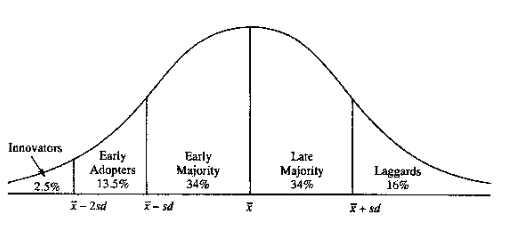
In the world of disruption, innovators, like me, are seen as crazy people. Innovators are way too comfortable with risk and ambiguity than the rest of the world. Early adopters admire the innovators’ adventurousness and they sift through the nutty notions and adopt the rational remainders. Early adopters are reliable, responsible people so when they buy an EV, the early majority will start to do the same. Outside of the US, the world has just entered the early adoption stage, which means the market is starting to heat up. Let’s take a look at the 2023 sales figures.
EV Sales, the Fuel of Diffusion
Based on the countries surveyed by Wards Intelligence, total global vehicle sales – light, medium and heavy-duty trucks – in 2023 topped 92 million units. Of those vehicles, the International Energy Agency says that approximately 18% or 16 million vehicles were EVs. In fact, in 2022, according to the World Economic Forum, global “EV sales leapt 55%”. Sales numbers indicate that global early adopters are starting to purchase EVs. The International Energy Agency reports that in the last three years the world went from very few EVs sold to 16 million sold/year. Countries like Norway (where climate change is very real) are purchasing almost 90% electric vehicles. China, based on heavy government incentives, is up to 40% of auto sales going to EVs while the US is barely hitting 10% of sales.
While the US pushes back against the EV disruption with a myriad of excuses, that is not the case globally. So, why the difference? It might be that these global buyers are not typical automotive consumers. In China leading EV manufacturers BYD and Chery employ many citizens so the Chinese might be developing an association with EVs through their work. Government incentives in China might be a little more compelling than a $7,500 tax credit in the US, just saying. In addition, there are large populations in China that can’t afford a traditionally priced car, so an inexpensive China built EV is compelling. In places like Norway where adoption has been climbing for the last decade, observability and trialability are very high. If 90% of sales are EVs that means your friends and neighbors and family members are likely to drive an EV. They say positive things and more people buy. The people who continue to drive an ICE vehicle start to look like polluters. In any event, these markets are outside of the mainstream…where disruption happens.
The China Disruption
According to Yahoo news, the average price of a US EV is $55,000. But the average price of a Chinese EV is $12,000 with some models coming in “less than the average e-bike”. “BYD just passed Tesla to become the top electric car producer on the planet.” Whoa! Further, according to Yahoo, China has the benefit of “cheap labor, a robust reserve of key minerals and hefty government investment,” which is why the US government felt it was necessary to tax the Chinese imports at 100%. This protects the US manufacturers for now, but deprives many Americans who can’t afford the steep cost of a new domestic EV.
MotorTrend recently reported that inexpensive, quality Chinese vehicles are roaring (well, not roaring, obviously) they are quietly rolling into dealerships around the globe. But because of high tariffs, they are not coming to the US. To combat this, several Chinese manufacturers like BYD and Chery have targeted Mexico as a manufacturing location. According to the NAFTA guidelines, if 75% of a car is built in North America, it can be imported tax free. But even then, a super low cost Chinese EV probably won’t turn many heads in the US. It won’t be on par with a normal US vehicle. So let’s leave the lucrative US market out for now. Let’s talk about non-consumers, the people who have never been able to afford a car, and the enormous impact a low cost ($4,000 – $12,000) Chinese EV might have on them.
Why do I predict the impact will be so significant? Because most of the world can’t afford a Chevy. So if you “need” transportation and your bank account says, all you can afford is a high end e-bike, a $4,000 – $10,000 Chinese EV is going to look great! It is going to have doors, windows that roll up and seats. It is going to be MUCH safer than a bike. There are approximately 1.4B vehicles on the road but there are 8B people in the world. What if the low cost Chinese vehicles were aimed at them? Some of them? A quarter of them? That’s a brand new market that the existing manufacturers couldn’t care less about serving. They don’t matter. Just like dog owners don’t matter to cat toy manufacturers and professional photographers didn’t matter to Fuji and Sony when they released digital cameras in the 1980s.
The new innovation is inferior to the existing product. I think it is reasonable to assume that a $10,000 BYD Seagull is going to be less impressive than a $40,000 Ford. Ford is not worried that their Ford Escape consumers are going to add the BYD Seagull to their comparison worksheet. But then the Seagull isn’t aimed at Ford customers. In April of 2024, BYD rolled it out in Columbia. It was aimed at Columbian youth. Ford probably wouldn’t spend ten cents advertising to Colombian youth, right? According to Ford News, in April of 2024, they sold 622 units and that was a 51% increase. It’s safe to say that Colombia is not a top market for Ford or any other mainstream manufacturer.
When the Colombian youth who were previous e-bikers buy a new BYD Seagull and have to go to work on a rainy day, they are going to arrive dry because their cheap Chinese EV has a roof and a windshield with wipers, unlike their bikes. All over the world, where people could only afford to walk or ride a bike, an inexpensive Chinese EV is going to change their lives. The relative advantage is HUGE!
You might say, now hold on, “what about the infrastructure, there’s no place to charge the car in Colombia?” Well, if you previously walked or took your bike to work or school or to the store, you probably weren’t going too far. So the miles you put on your new inexpensive Chinese EV can likely be replenished by plugging your car into a “110” (or the Colombian equivalent) when you get home. My son and my brother-in-law both charge their Tesla Model 3s using an ordinary 110 outlet and while it might be time consuming, it works just fine. So if you can plug in a lamp in Colombia, you can charge your Chinese EV.
Cost of EV Ownership
The other advantage EVs will have as they roll into these new markets is the cost of ownership. The price of the vehicle is certainly the biggest part, but the cost of maintaining an EV is a fraction of the cost of an ICE vehicle.
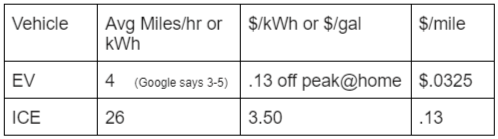
It is ~4 times the cost to own/drive an ICE and that is just gas. There are no oil changes in an EV. The only fluid is washer fluid. I have 53,000 miles and no brake issues. That means that as these low cost EVs start rolling out, poorer people can afford to buy and own them. Adoption from that giant population will significantly accelerate the diffusion.
Moving into Mainstream
Now, if the current global sales momentum continues for the cheap Chinese EVs, the profits will fuel the improvement of the inexpensive Chinese EVs. The Chinese will create new models with more luxurious interiors and higher crash ratings. If the momentum improves further the BYD vehicles theoretically will meet and exceed the mainstream models. Just like the digital camera went from fuzzy pictures to superior clarity and 35mm cameras moved into thrift stores. The profits from Seagull sales can help BYD build plants in the US thus eliminating the tariffs and opening up a 20M vehicle/year market. They might build out infrastructure like Tesla did, making charging faster and more convenient in remote areas of the world. They will also start the ball rolling for other non-mainstream manufacturers to start building EVs to very basic standards in order to compete. Once a $4,000 car is built and sold other manufacturers realize it’s possible and the snowball starts to roll down the hill. Remember the first guy who ran the four minute mile? It was Roger Bannister in 1954, but 46 days later, John Landy broke the record. Once someone proves it is possible, then resistance is just failure.
The Chinese have the benefit of history as well. I am old enough to remember the resistance and import taxes on early Japanese vehicles. My Dad started his career at GM in the 1960s and compared the sound of the early “cheap Japanese built engines” to his lawn mower. He said the horn sounded like something you’d screw onto a bike. The last car my Dad bought, after he retired, was a Hyundai, so even laggards, like my Dad, eventually came around. And let’s say the Chinese never infiltrate the US market? Who cares! They are opening up a new market made up of billions of consumers who couldn’t previously afford a vehicle. They are not worried about existing markets.
The Dominant Design
This is the real consideration. Based on where we are in the adoption cycle of EVs (2.8% – the beginning of Early Adopters), the dominant design has yet to be determined. When the original automobiles were diffusing, the dominant design was set in 1920 about 20 years after automobiles were first introduced and well into the early majority of adopters (about 50% of diffusion). The dominant design indicates that the majority of customers have switched from the previous version of a product to a specific design of a new product. Because EV sales are accelerating faster outside of the US, that might indicate that the dominant design will be established elsewhere and the US market would have to adapt. That would be a problem for the US mainstream manufacturers. If the dominant design for EVs ends up being a $10,000 BYD Seagull how is anyone else going to compete? Even with a 100% tariff, it would still be one of the cheapest cars in the US according to Cars.com, in April 2024.
There won’t be a tariff on the BYD Seagull in many countries, in places where the US manufacturers don’t sell vehicles…outside of the mainstream…where disruption happens.
Advice about Distractions
Don’t distract yourself with things that the current ICE market customers/manufacturers are complaining about:
- The safety and capability of autonomous driving – forget it. That’s an advanced function – Chinese EV customers are not going to buy that for a long time. They will be thrilled not to be walking or riding a bike in the rain.
- Infrastructure – They are going to plug their new EV into the outlet for their lamp and charge overnight. It will be fine.
- Range anxiety – They don’t go far. They usually walk or ride a bike. How far can they go in a day? Seriously, How far do you drive in a day?
- Tesla is not the problem. Tesla says it will be very difficult to compete with $4,000-$11,000 Chinese EVs, they are going to have huge issues too.
- Forget about how this will work with your current processes, if you have to consider that, you are already losing. This will be very iterative, you are competing on a different stage. They have built a viable, cheaper than $10,000 car!
- Forget about 5 star crash ratings – How safe is it to ride a bike or walk in downtown Mumbai. Whatever you build will be safer than that.
- Forget about in house programming, you are competing with a technology firm. Standardize on available software like Waze, Airplay.
- You’re competing with an e-bike.
- Stop talking to your current consumers…If you could make an EV with a 650 mile range and electric “pumps” at every gas station and a perfectly safe autonomous function, how many ICE customers would convert? Probably less than you think. My friends tell me they prefer the sound of an ICE vehicle. I remember hearing that same excuse a long time ago…
Decades ago I worked on getting secretaries to switch from a typewriter to a PC. It was very slow at first. The secretaries hated the way the PC keyboard sounded and felt under their fingertips. For those of you that have no idea what a typewriter sounded like…The typewriter had a loud mechanical sound and you needed to push hard to get the keys to work.
Within ten years of the first PC sold with Microsoft Word, most of the secretaries were gone because younger managers started typing their own messages on their own PCs because it was faster, more efficient and more secure/private. Imagine if every email you sent had to first be dictated to a secretary, then reviewed for accuracy, then retyped and sent out. I’m sure you can’t even imagine it and yet it was the case thirty five years ago. It was the combination of PC hardware technology and Microsoft Word that made the difference. It was a partnership. The hardware manufacturers partnered with the software people.
We probably have less time until people can’t even imagine the noisy ICE vehicles with their carbon emissions and bellowing horns.