When the U.S. and Israel launched Operation Epic Fury on February 28, 2026, most headlines focused on oil prices and geopolitical fallout. If you work in MedTech supply chain or trade compliance, you should be looking somewhere else.
The Strait of Hormuz is effectively closed to commercial shipping. The air cargo hubs your freight moves through like Dubai, Doha, Bahrain are no longer options and the sanctions lists your compliance team screens against just got longer, across multiple jurisdictions, all at once.
Why the Strait Matters More Than It Looks
Most people know the Strait of Hormuz as an oil story. About 20 million barrels a day flow through that 33-kilometer passage between Iran and Oman, roughly 20% of the world’s petroleum liquids. When it closes, oil prices move, which is what we are seeing today.
But the Strait isn’t just an oil chokepoint. Dubai, Doha, Kuwait City, and Jeddah all sit on the other side of it. These are the logistics hubs your freight probably moves through. Pharmaceutical air cargo from India, semiconductor shipments from Asia, temperature-sensitive biologics heading into European hospital systems. When those hubs go down, the impact is immediate.
Iran sanctions are not new. OFAC has administered restrictions under the Iranian Transactions and Sanctions Regulations (31 C.F.R. Part 560) for decades. But the designation environment going into this conflict was already tightening: the EU formally designated the IRGC a terrorist organization in January 2026, and OFAC added 30 Iranian entities and vessels to the SDN list in February. Operation Epic Fury didn’t create a sanctions problem; it accelerated one that was already building.
Where MedTech Supply Chains Are Actually Exposed
Medical device supply chains are long and fragmented like most. Here’s where the Iran conflict is creating real pressure, right now:
- Petrochemical inputs: Plastics, polymers, single-use packaging, etc. are sourced from Gulf petrochemical feedstocks that supply a significant share of the raw materials used in device components and packaging. Disruption to production and export from the region means higher input costs and longer lead times for manufacturers.
- Semiconductors and electronics: Imaging systems, patient monitors, connected diagnostics all depend on semiconductor components that largely move through Gulf shipping lanes from Asia. Sea closure compounds the airspace problem.
- Indian API and reagent exports: India is one of the world’s largest exporters of active pharmaceutical ingredients and diagnostic reagents. The fastest route to European and U.S. markets? Through Dubai International and Hamad International airports in Doha. Both are closed.
- Sterilization gases: Ethylene oxide is still the dominant sterilization method for roughly half of all sterilized medical devices and is derived from petrochemical feedstocks. Gulf supply disruption is already pressuring EO availability and pricing.
- Cold chain and time-sensitive biologics: In-vitro diagnostics, reagent kits, and biologics move by air because they have to. There is no slow boat option. These products are feeling the impact most immediately.
What’s Actually Happening Right Now
Ocean Freight: Both Escape Routes Are Gone
Before this conflict, MedTech logistics teams were already dealing with residual Red Sea/Suez disruptions from Houthi activity. Maersk had just resumed Suez transits. Now both the Strait of Hormuz and the Red Sea are effectively closed, which means the only viable ocean route for most cargo is the Cape of Good Hope and that is adding 10 to 14 days per shipment, pulling vessel capacity out of rotation, and driving up ocean rates for everyone.
As of early March, at least 150 tankers were sitting at anchor in open Gulf waters, unable to move. War-risk insurance premiums, which ran around 0.125 to 0.4% of vessel value before the conflict, have been repriced to levels that are effectively prohibitive, and several major insurers have suspended Gulf coverage entirely.
Air Cargo: This is the MedTech-Specific Crisis
Energy analysts are focused on tankers. Supply chain teams in MedTech should be focused on air freight. High-value medical products, diagnostics, biologics, reagent kits all account for roughly 35% of global trade value by dollar amount while representing less than 1% of freight volume. These shipments move by air because they have to.
Dubai, Doha, Bahrain, Kuwait, and Iraq airspace are all closed. The cargo that was routing through these hubs, much of it Indian API exports and Asian electronics components headed to European hospitals and distribution centers have nowhere to go. Maersk has already flagged rising air freight rates and airlines are adding war-risk surcharges. If your organization runs lean inventory on fast-moving diagnostics or cold-chain biologics, you’re not looking at a theoretical risk. You’re looking at a lead-time problem that’s happening right now.
Sanctions: Your Screening List Just Got Longer Overnight
Nobody in your logistics org woke up Monday morning and thought today looks like a good day for compliance risk! (At least I hope not. If so, you may need a new compliance team.) but the conflict didn’t just disrupt trade routes. It triggered a coordinated multilateral expansion of Iran-related sanctions lists. Here’s where things stand as of early March 2026:
- OFAC/U.S.: Expanded SDN designations on Iranian entities, vessels, and IRGC-linked intermediaries. The General License for medical device exports (31 C.F.R. § 560.530) is still in effect for humanitarian purposes, but the excluded persons list has grown.
- European Union: Formally designated the IRGC as a terrorist organization in January 2026, creating new screening obligations for European-based MedTech subsidiaries and distributors.
- United Kingdom: Added 10 Iranian officials, including IRGC members, to the UK sanctions register in February 2026.
- Australia: Designated 20 Iranian individuals and 3 organizations in February 2026. [4]
- Ukraine: Designated the IRGC as a terrorist organization, reflecting broader multilateral alignment.
The compliance exposure in this environment isn’t with your direct customers and suppliers. It lives in the middle layers. The freight forwarder you’ve used for years who quietly subcontracts to a Gulf logistics agent, the sub-distributor in Turkey who reroutes through Iranian-adjacent networks, the new carrier relationship your logistics team spun up this week because their primary partner suspended service. Every one of those is a new screening obligation under OFAC, the EU Consolidated List, the UK Financial Sanctions List, and now Australian and Ukrainian designations too.
Most MedTech compliance programs were not designed for this. They were built around periodic batch screening. Run the list weekly or monthly, document it, move on. That model breaks in this environment when the SDN list is expanding in real time across multiple jurisdictions simultaneously. The window between a new IRGC-affiliated entity being designated and that entity appearing in your logistics chain can be days. If your screening runs on a weekly batch, you are operating blind for most of that window.
There is also a specific OFAC licensing risk that is easy to miss right now. The General License for medical device exports to Iran (31 C.F.R. § 560.530) is still in effect, meaning humanitarian and certain commercial medical device shipments to Iran remain authorized. But that license has a caveat: it does not apply to transactions involving individuals or entities on the SDN list. With the SDN list expanding rapidly, companies with any existing Iran-adjacent distribution, clinical trial activity, or humanitarian shipments need to verify their current transaction parties against the updated list immediately. The license hasn’t changed. The list under it has.
Risk Assessment by MedTech Product Category
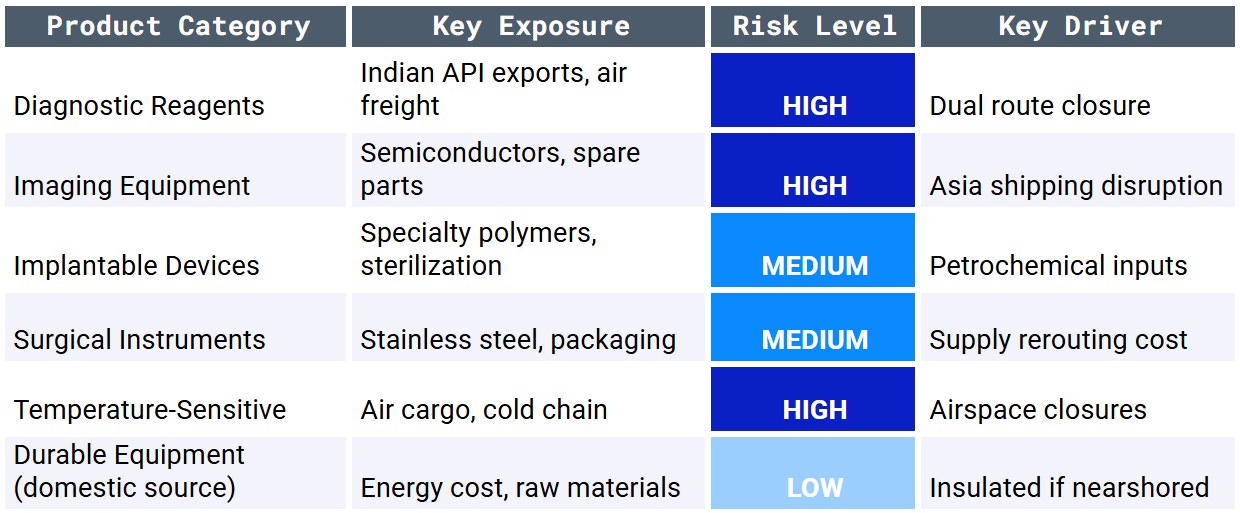
Note: Risk ratings reflect supply disruption and compliance exposure as of March 9, 2026, and may shift as the conflict evolves.
What This Looks Like in Practice
Think about any mid-size IVD company running a lean hub model out of Dubai, and there are dozens of them, their Indian reagent supplier ships to DXB, it transits to Frankfurt or Amsterdam, last mile to the hospital network. That whole chain is four days on a good week. Right now it’s sitting idle, and the alternative routing their forwarder quoted adds two days and a cold-chain handoff that wasn’t in the original validation. That’s not a logistics problem anymore. That’s a QMS problem.
The compliance layer makes it worse. That same company can’t just call the next forwarder on the list. Every new logistics partner is a screening event. That new forwarder needs to be screened against denied party and sanctions lists. And not just the forwarder. Their sub-agents as well. If that forwarder’s network touches any Iranian-affiliated entity designated in the last two weeks, you have an OFAC exposure that didn’t exist the week before your logistics team made the call. And they made it fast, because the product is sitting. This is the scenario playing out across the diagnostics and biologics segment. The companies that are ahead of it aren’t the ones with the biggest legal teams. They’re the ones whose compliance system flagged the new designation before the forwarder contract was signed, not after the shipment moved. Businesses relying on manual screening are making that call under time pressure with incomplete information. That’s precisely where enforcement actions originate.
There’s an additional wrinkle for companies that have ever shipped devices to Iran under the 31 C.F.R. § 560.530 General License for humanitarian purposes, clinical trials, or authorized commercial distribution. Those companies need to re-verify that none of their Iranian transaction parties appear on the newly expanded SDN list. The license is still valid. But its scope just got narrower without the Treasury sending a notice.
The ocean freight side isn’t much better. Again, take any imaging OEM whose spare parts hub runs through Dubai, their semiconductor components from Taiwan are now sitting on vessels rerouting around the Cape, minimum 7 to 10 additional days, assuming they can even get vessel capacity. The instinct is to find alternative logistics partners fast Turkey, Eastern Europe, Southeast Asia. That instinct is right. But every one of those new relationships is a screening event. European subsidiaries face IRGC-related obligations that didn’t exist six months ago, and logistics providers in Turkey and Eastern Europe with any Iran-adjacent history need to be evaluated against the full multilateral landscape, not just OFAC. Try doing that manually across 5 to 10 candidate partners while your service team is fielding escalations because spare parts aren’t showing up. It doesn’t work. The companies managing this well have screening that runs continuously and flags a newly designated entity before the next shipment moves, not on the next weekly batch cycle.
What MedTech Companies Should Do This Week
- Move to continuous restricted party screening immediately, not next quarter. If your program runs on weekly or monthly batch processing, you have an active gap right now. New IRGC-affiliated designations across OFAC, EU, UK, and Australian lists are being issued in days. Continuous screening means your system flags a newly designated entity the moment it appears before your next shipment moves, not after. Apply this to your full third-party universe: freight forwarders, sub-distributors, logistics agents, carriers, and their known sub-contractors.
- Screen every new logistics relationship before the first transaction. Rerouting your supply chain means engaging new partners you haven’t worked with before. Do not let urgency shortcut the screening process. Run each candidate against the full multilateral list stack OFAC SDN, EU Consolidated List, UK Financial Sanctions List, and Australian/Ukrainian registers. Document it. If the new partner has any Iran-adjacent history, escalate before proceeding.
- Audit your OFAC General License position if you have any Iran-adjacent activity. The 31 C.F.R. § 560.530 General License for medical devices is still in effect, but it excludes transactions with SDN-listed entities. With the SDN list expanding rapidly, any existing authorized activity, humanitarian shipments, clinical trials, authorized commercial distribution to Iran needs a fresh transaction-party check against the current list. The license didn’t change. The parties under it may now be excluded.
- Rebuild your landed cost models for the Cape rerouting reality. Cape of Good Hope routing adds 10 to 14 transit days plus meaningfully higher fuel costs, war-risk insurance (if available at all), and port congestion surcharges. Your duty deferral calculations, FTZ admission entries, and total landed cost figures are all stale if they were built on pre-conflict assumptions. Get accurate numbers before you quote lead times or costs to internal stakeholders.
- Call your freight insurer before you move the next vessel. War-risk coverage for Gulf transits has been suspended or repriced to functionally uninsurable levels by several major carriers. Understand exactly what your current policies cover, what the coverage gap is for your rerouted carrier alternatives, and what your financial exposure is per shipment before you commit.
- Get leadership aligned on Section 232 medical device tariff risk. IEEPA tariffs are gone, but the Section 232 investigations into medical devices are still active and a conflict-driven supply disruption plus a new tariff layer is a compounding planning problem. This is not a procurement issue. It is a regulatory and financial planning risk that needs to be on the executive agenda.
Monitoring Indicators. What to Watch
- Daily: OFAC SDN list updates (home.treasury.gov/policy-issues/financial-sanctions/recent-actions) new designations are occurring at elevated frequency
- Daily: UK UKMTO advisories (ukmto.org) for Strait of Hormuz and Gulf of Oman vessel incident reports
- Weekly: Maersk and Hapag-Lloyd operational updates for Strait/Red Sea routing status
- Weekly: MarineTraffic vessel density data for Hormuz transit recovery indicators
- Weekly: BEA/EIA energy data for Gulf petroleum export recovery
- As-published: EU, UK, Australian sanctions list amendments via official government registers
- As-published: FDA drug and device shortage notices that reference supply chain disruption
- As-published: OFAC guidance on General License applicability to conflict-affected entities
The Bottom Line
The companies that are going to navigate this well aren’t the ones with the biggest legal teams or the most aggressive stockpiling strategies. They’re the ones who know where their freight is, who’s touching it, and whether every party in that chain is still clean on the SDN list in real time, not last quarter.
Every rerouted shipment is a new compliance decision. Every alternative freight forwarder is a new screening obligation. In a week where OFAC, the EU, the UK, and Australia all expanded their Iran designation lists at the same time, batch screening isn’t a compliance program. It’s a liability.
Trade compliance has always been important in MedTech. Right now, it’s the difference between companies that keep moving products and companies that don’t.
Key Takeaways
- The U.S. and Israel’s Operation Epic Fury (launched Feb. 28, 2026) has effectively halted commercial shipping through the Strait of Hormuz, impacting roughly 20% of the world’s daily oil supply and broad cargo flows.
- Major carriers like Maersk, Hapag-Lloyd, CMA CGM and others have suspended Strait transits and are rerouting around the Cape of Good Hope, adding 10–14 days to journey times.
- Pharmaceutical exports from India and semiconductors from Asia, both critical MedTech inputs, face significant delays as air cargo hubs across the UAE, Qatar, and Bahrain are closed.
- New multilateral IRGC designations (EU, UK, Australia) mean MedTech companies face an expanded restricted party screening universe with heightened enforcement risk.
- Companies with mature trade compliance capabilities, particularly real-time restricted party screening and dynamic landed cost tools are better positioned to navigate rerouting, new carrier selection, and evolving sanctions lists.
References
[1] U.S. Energy Information Administration. “Strait of Hormuz is the world’s most important oil transit chokepoint.” Government. https://www.eia.gov/todayinenergy/detail.php?id=61002. Accessed 2026-03-09.
[2] U.S. Treasury, OFAC. “Iranian Transactions and Sanctions Regulations, 31 C.F.R. Part 560 — General License 560.530.” Government. https://ofac.treasury.gov/sanctions-programs-and-country-information/iran-sanctions. Accessed 2026-03-09.
[3] Al Jazeera. “Iran slams ‘selective outrage’ after EU labels IRGC a ‘terrorist’ group.” Media. https://www.aljazeera.com/news/2026/1/29/iran-slams-selective-outrage-after-eu-labels-irgc-a-terrorist-group. Published Jan. 29, 2026. Accessed 2026-03-09.
[4] Wikipedia. “International sanctions against Iran.” Reference. https://en.wikipedia.org/wiki/International_sanctions_against_Iran. Accessed 2026-03-09.
[5] Associated Press. “Supply chain disruptions from conflict in Iran could raise prices for drugs, electronics and more.” Media. https://www.capitalgazette.com/2026/03/04/supply-chain-iran-war/. Published March 4, 2026. Accessed 2026-03-09.
[6] CNBC. “The Strait of Hormuz crisis explained: What it means for global shipping.” Media. https://www.cnbc.com/2026/03/02/strait-of-hormuz-crisis-us-iran-israel-war-shipping-trade-oil.html. Published March 2, 2026. Accessed 2026-03-09.
[7] Castor Vali. “Iran Crisis 2026: Strait of Hormuz Closure and Commercial Shipping Risk.” Industry Analysis. https://www.castorvali.com/news/iran-strait-of-hormuz-shipping-crisis-2026/. Published March 3, 2026. Accessed 2026-03-09.
[8] Janes. “Iran conflict 2026: Disruption to Strait of Hormuz increases energy and food production risks.” Defense/Intelligence Analysis. https://www.janes.com/osint-insights/defence-and-national-security-analysis/iran-conflict-2026-disruption-to-strait-of-hormuz-increases-energy-and-food-production-risks. Published March 2, 2026. Accessed 2026-03-09.
[9] Al Jazeera. “Iran says will attack any ship trying to pass through Strait of Hormuz.” Media. https://www.aljazeera.com/news/2026/3/2/iran-says-will-attack-any-ship-trying-to-pass-through-strait-of-hormuz. Published March 2, 2026. Accessed 2026-03-09.
[10] Direct Relief. “Escalating Middle East Conflict Strains Health Systems and Disrupts Humanitarian Supply Routes.” NGO. https://www.directrelief.org/2026/03/escalating-middle-east-conflict-strains-health-systems-and-disrupts-humanitarian-supply-routes/. Published March 4, 2026. Accessed 2026-03-09.
[11] Wikipedia. “2026 Strait of Hormuz crisis.” Reference. https://en.wikipedia.org/wiki/2026_Strait_of_Hormuz_crisis. Accessed 2026-03-09.
[12] CNBC. “The Strait of Hormuz is facing a blockade. These countries will be most impacted.” Media. https://www.cnbc.com/2026/03/03/strait-of-hormuz-closure-which-countries-will-be-hit-the-most.html. Published March 3, 2026. Accessed 2026-03-09.