A practical, expert guide to how modern ERP platforms, especially QAD, secure enterprise data with cloud-first controls, embedded compliance, layered defenses, and AI-assisted operations that reduce risk, speed audits, and cut downtime.
Introduction
Enterprise resource planning systems sit at the center of modern operations, connecting finance, supply chain, manufacturing, and customer data. As mid‑market manufacturers and global enterprises accelerate digital transformation, their ERP platform must operate with security built in, not bolted on. Below, we unpack how a cloud‑first ERP like QAD protects data every day, aligns with leading regulations, and enables proactive, AI‑assisted defense without slowing the business.
Key takeaways
If you read nothing else, these are the top actions and assurances to anchor your ERP security strategy with QAD.
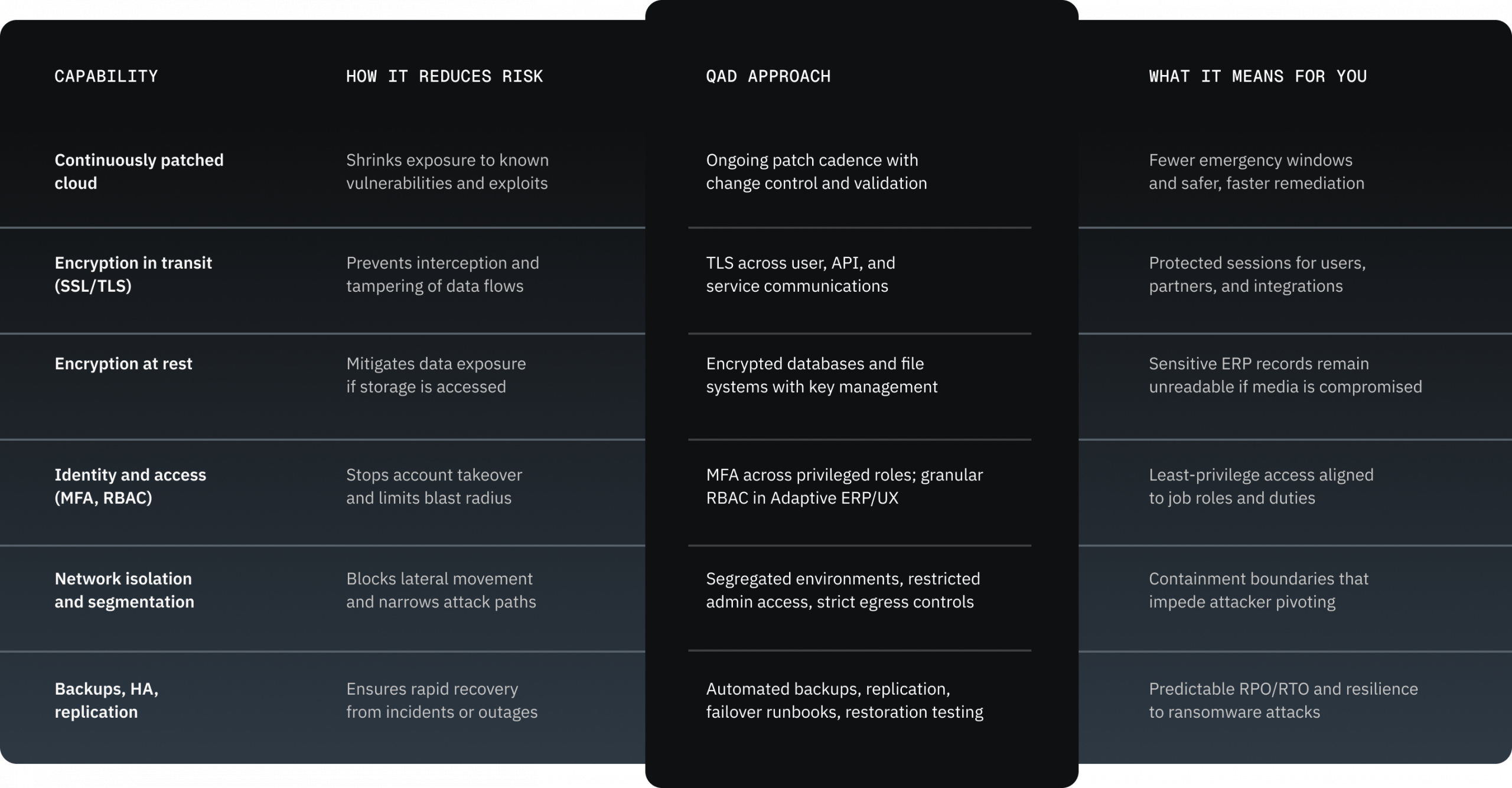
- QAD’s cloud applies continuous patching, SSL/TLS and at‑rest encryption, MFA and RBAC, segmentation, and resilient backups to reduce risk and speed recovery.
- QAD aligns with ISO/IEC 27001:2022, SOC 1 Type 2, SOC 2 Type 2, GDPR, 21 CFR Part 11, NIS2, TISAX, NIST 800‑171, CMMC, and ITAR to streamline audits with logging, change tracking, and access reviews.
- QAD enables layered controls like MFA, RBAC, automated patching, SIEM monitoring, testing, and practiced recovery, while ChampionAI improves data accuracy and operational visibility.
Why ERP security matters now: The risk landscape for enterprise data
Cyber threats are evolving faster than ever, and attackers increasingly target ERP systems because they aggregate sensitive records and control critical processes. For manufacturers, a ransomware event can idle plants, disrupt supplier commitments, and cascade into missed customer shipments, costs that are measured not only in recovery spend but in lost margin and reputation. Similar pressure exists in finance, where downtime delays closes and clouds revenue visibility.
ERP is a central data hub spanning financials, supply chain, production quality, and intellectual property. That concentration of value makes it a high‑priority target for credential theft, integration abuse, and data exfiltration. As organizations adopt cloud services and expand integrations with partners, MES, PLM, EDI, and analytics, the attack surface grows, especially if identity, patching, and monitoring aren’t consistently enforced across the ecosystem.
Security, therefore, isn’t a blocker to transformation; it’s the enabler of resilience and trust. A platform approach, combining hardened cloud operations, embedded compliance, and proactive defense, keeps your ERP dependable under stress. QAD’s security-first, cloud-delivered model brings those pillars together, with continuous monitoring (including SIEM integrations) and AI assistance via ChampionAI to help teams identify data inconsistencies, missing information, and operational risks earlier.
Cloud security, done right: How modern ERP clouds protect your data
Modern ERP clouds reduce risk by centralizing operations on hardened, continuously patched infrastructure. By removing the burden of on‑premise maintenance, you shrink exposure windows between a disclosed CVE and deployed remediation. QAD’s cloud operations apply secure‑by‑default baselines, change control, and ongoing configuration hardening so customers inherit strong posture from day one.
Encryption is table stakes, and it must be end‑to‑end. In transit, SSL/TLS protects sessions between users, services, and integrations. At rest, database and file‑level encryption safeguard financial records, production data, and IP from unauthorized access. QAD implements both, pairing encryption with strict key management practices to reduce the blast radius of any compromised component.
Identity is your new perimeter. With multifactor authentication (MFA) and role‑based access control (RBAC), least‑privilege access is enforced across QAD Adaptive ERP and integrations. Fine‑grained roles limit what users and service accounts can view or change, while session controls and conditional policies further reduce the risk of credential misuse.
Reliability and recovery complete the picture. Automated, policy‑driven backups, high availability, and cross‑region replication help you recover rapidly from incidents or outages. Off‑prem storage and immutability options protect backups from ransomware tampering, and regular restoration tests validate that recovery points and times meet business needs. QAD’s emphasis on availability and attested security practices means your ERP remains both secure and dependable.
Compliance built in: Meeting global and industry regulations with QAD
Regulators and customers expect proof that enterprise data is protected. ERP platforms streamline compliance by embedding policy enforcement, audit trails, and access governance, so evidence is generated as a byproduct of daily operations rather than a scramble at audit time.
Logging, change tracking, and periodic access reviews are central. With QAD, granular audit logs record who did what and when across finance and operations. Change controls document configuration updates, while tools for access certification make it straightforward to verify least‑privilege and segregation of duties. These controls shorten audit cycles and increase confidence with internal and external auditors.
QAD maintains a strong alignment with leading frameworks that are commonly requested in vendor risk and regulatory reviews. This includes ISO/IEC 27001:2022 for information security management, SOC 1 Type 2 and SOC 2 Type 2 attestations for controls over financial reporting and service trust, and GDPR considerations for personal data handling. For manufacturers with specialized obligations, support extends to 21 CFR Part 11, NIS2, TISAX, NIST 800‑171, CMMC, and ITAR contexts.
For SOX and related access governance, teams can leverage logging and analysis tools, including QAD’s Access Security Data Loader—to expedite entitlement reviews, toxic combination checks, and change documentation. The result is a repeatable, defensible process that reduces findings, mitigates risk, and frees your team to focus on improvement rather than paperwork.
- ISO/IEC 27001:2022 information security management alignment
- SOC 1 Type 2 and SOC 2 Type 2 attestations for control effectiveness
- GDPR considerations for processing and protecting personal data
- 21 CFR Part 11 support for electronic records and signatures
- NIS2 readiness considerations for essential service operators
- TISAX alignment for automotive information security assessments
- NIST 800‑171 and CMMC support for CUI protection requirements
- ITAR considerations for export‑controlled technical data
Proactive defense measures: A layered security model for ERP
Strong ERP security combines prevention, detection, and recovery. The goal is to make compromise harder, spot anomalies faster, and recover with minimal impact if an incident occurs. A layered model, identity, patching, monitoring, testing, and training, creates overlapping controls so one gap doesn’t become a breach.
Start with identity. Enforce MFA for all admins and sensitive roles, standardize RBAC across QAD and connected systems, and apply session controls like timeouts and conditional access. In practice, this stops credential stuffing and limits the blast radius if a password is phished.
Automate patching everywhere you can. Apply updates to the ERP core, connectors, and middleware as part of a disciplined cadence tied to CVE severity. This reduces the window between disclosure and remediation, a favorite attacker opportunity—without waiting for a quarterly change window.
Visibility is non‑negotiable. Integrate ERP logs with your SIEM to correlate login anomalies, permission changes, and integration behavior. Add anomaly detection to surface outliers like mass data exports at odd hours or privilege escalations without approval.
Finally, plan for the worst. Schedule third‑party security assessments and penetration tests, validate backup integrity, and rehearse disaster recovery runbooks. When a ransomware or insider threat scenario occurs, practiced recovery is what turns a major outage into a controlled event.
- Enforce MFA and RBAC everywhere, including privileged and service accounts.
- Harden credential hygiene with strong policies, rotation for shared/integration keys, and session timeout controls.
- Automate patching and configuration baselines to minimize exposure to known CVEs.
- Continuously monitor with SIEM integrations; alert on anomalous logins, mass exports, and unauthorized role changes.
- Conduct third‑party security assessments and penetration testing at least annually.
- Engineer backup, DR, and business continuity with defined RPO/RTO; test restorations and failover regularly.
- Provide targeted security awareness for ERP users and admins; measure phishing resilience and access review completion.
AI-assisted operations with QAD ChampionAI
AI complements QAD’s security controls. Within the QAD ecosystem, ChampionAI is designed to improve the quality, structure, and timeliness of operational data flowing through ERP and supplier communications.
By mapping, validating, and continuously updating data across orders, documents, and supplier interactions, ChampionAI helps ensure that teams are working with accurate and complete information. This reduces blind spots caused by missing, outdated or inconsistent data.
Security features in QAD ERP: What’s included out of the box
Identity and access are first‑class in QAD Adaptive UX. Native MFA and granular RBAC let you enforce least‑privilege access by job function, with approval workflows for privileged elevation and comprehensive session logging.
Data is protected in motion and at rest. SSL/TLS secures data in transit across user sessions and APIs, while encrypted databases safeguard stored records. Encryption and access controls extend to integrations so partner connections inherit the same protections.
Operational visibility and resilience are built in. Fine‑grained audit trails support investigations and compliance, while integration hooks feed your SIEM and alerting pipelines to surface suspicious activity. Automated backups and recovery options ensure the ERP stays available even when incidents occur.
Implementation playbook: Steps to operationalize ERP security
Turn strategy into outcomes with a pragmatic rollout plan. Anchor policies to the frameworks you must meet, SOX, ISO/IEC 27001:2022, GDPR, and where applicable NIST 800‑171/CMMC and ITAR, and define measurable controls and owners.
Harden identity from day one. Rationalize roles, apply segregation of duties, enable MFA everywhere, and lock down privileged access. Use temporary elevation for admin tasks and review access regularly.
Wire up monitoring and response. Stream ERP, infrastructure, and integration logs to your SIEM, then tune detections for login anomalies, mass exports, and unauthorized role changes. Define on‑call rotations and playbooks for containment and communication.
Validate resilience continuously. Establish RPO/RTO targets, test restorations and failover, and conduct tabletop exercises. Add ongoing user education, targeted to ERP users and admins—and measure outcomes like phishing click rate and access review completion.
- Baseline risks and compliance obligations; document policies mapped to ISO/IEC 27001:2022, GDPR, SOX, and where required NIST 800‑171/CMMC and ITAR.
- Model roles and SoD; enable MFA and session controls; restrict and monitor privileged access.
- Integrate logs with SIEM; define detection rules, suppression logic, and response workflows.
- Harden configurations; automate patching across ERP and connectors; track remediation SLAs by CVE severity.
- Set DR objectives; schedule and pass restoration/failover tests; store immutable/off‑site backups.
- Run security awareness for ERP personas; measure and report hygiene metrics to leadership.
- Continuously improve with quarterly posture reviews and audit readiness checks using QAD’s access and logging data.
Choosing a trusted partner: Why QAD for secure digital transformation
Modernizing ERP shouldn’t mean trading agility for risk. QAD’s cloud‑first, security‑by‑design approach helps manufacturers and mid‑market enterprises move faster with confidence, combining hardened operations, strong identity, encryption, and resilient recovery.
Certifications and audit‑ready practices, spanning ISO/IEC 27001:2022 alignment, SOC 1 Type 2 and SOC 2 Type 2 attestations, and GDPR considerations, reduce compliance overhead and accelerate due diligence with customers and regulators.
Layered defenses and SIEM integrations provide a strong security foundation, while AI assistance through ChampionAI improves data reliability and data hygiene. If you’re ready to assess your current posture and map a secure transformation path, engage QAD to explore a security assessment or roadmap workshop tailored to your environment.
Frequently Asked Questions
How do modern ERP clouds like QAD protect enterprise data day to day?
They centralize operations on hardened, continuously patched infrastructure; encrypt data in transit (SSL/TLS) and at rest; enforce MFA and RBAC for least‑privilege access; segment networks to limit lateral movement; and maintain automated backups, high availability, and replication for rapid recovery. Monitoring and logging feed SIEM pipelines for continuous visibility.
Which compliance frameworks does QAD support to simplify audits and regulatory obligations?
QAD aligns with ISO/IEC 27001:2022 and maintains SOC 1 Type 2 and SOC 2 Type 2 attestations. It supports needs related to GDPR, 21 CFR Part 11, NIS2, TISAX, and, for manufacturers handling controlled data, NIST 800‑171, CMMC, and ITAR contexts. Audit trails, change tracking, and access reviews streamline evidence collection.
What proactive defense measures and AI capabilities strengthen ERP security with QAD?
A layered model – including MFA, RBAC, automated patching, SIEM monitoring, third-party testing, and practiced backup/DR – helps prevent, detect, and contain threats. ChampionAI complements this by improving the quality and visibility of operational data.