Product Structures
This chapter discusses how product structures—also known as bills of material—are defined and used during MRP and other planning activities to determine what materials are required for manufacturing.
IntroductionOutlines the use of product structures and formulas as interdependent variables that describe the relationship between products and components.
BOM CodesOutlines the Bill of Materials (BOM) codes and the programs used to set them up.
Alternate Structures/FormulasDescribes alternative methods for using BOM codes and product structures depending on how an item will be used.
PhantomsDefines phantoms and explains how to identify them, how to use them effectively, and changes that may be required to use them.
Using Product Structure MaintenanceDescribes how to define Product Structures and describes important fields in Product Structure Maintenance (13.5).
Related TopicsDescribes some topics that are related to product structures and how they are used.
Introduction
Product structures and formulas are much like the list of ingredients for a recipe—they indicate the components and quantities needed to make a product. Unlike a recipe, in many cases, these documents also list the ingredients for each component. Graphically, if a formula or product structure is considered in its entirety, it looks like a tree, with the parent item at the top (level 0) and all the components branching off down to the raw material level (levels 1, 2, 3, and so on).
Product structures are recorded as single-level relationships between parent (or higher-level items) and component items. For formulas, these are the relationships between products and ingredients.
Product structures are modular. Separate structures are entered for finished goods and lower-level assemblies or intermediate products. So, a component in a higher-level structure might be a parent in a lower-level structure. Looking in the other direction, a parent in a lower-level structure can be a component in a higher-level structure. The system can display product structures as either indented, multilevel bills of material or as single-level bills.
This chapter uses an example of a manufactured product with both a product structure and a formula: sports sunglasses with specially coated lenses.
Viewed from the top, three components make up the parent product: a frame assembly, a left lens, and a right lens. Each component has its own structure. The frame assembly includes a lens frame, left and right sides, and so on.
Product Structure for Sunglasses with Coated Lenses illustrates this two-level product structure.
Product Structure for Sunglasses with Coated Lenses
|
Frame Assembly
|
Left Lens
|
Right Lens
|
|
Lens frame
|
Lens blank
|
Lens blank
|
|
Left temple
|
Tint
|
Tint
|
|
Left hinge kit
|
Coating
|
Coating
|
|
Right temple
|
|
|
|
Right hinge kit
|
|
|
|
Screws (2)
|
|
|
|
Adhesive
|
|
|
If a single company manufactures the whole product, each structure has its own specific manufacturing steps:
• Assemble frames.
• Grind lenses to size, polish, tint, and coat.
• Assemble sunglasses from frames and lenses.
Or the company might buy the frames, only doing lens grinding, coating, and final assembly. Because it might be necessary to ensure a supply of spare screws, the frame can have its own product structure so the product structure reports show which frames require these screws.
You can enter product structures for purchased products without affecting planning or product costing programs. This way, you can use all the product structure reporting tools for component and parent items, regardless of the source of the items.
The system also uses product structure records to store alternate bills of material, planning bills, and configuration bills. Separate these from standard bills by using a structure code.
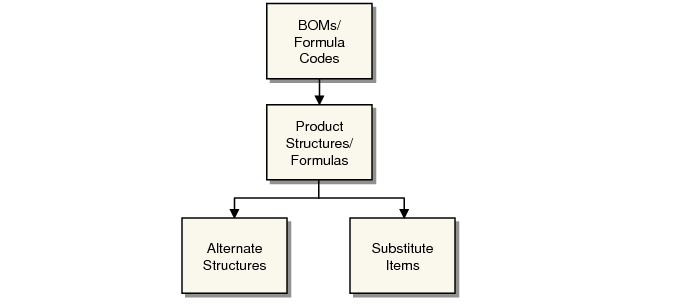
Product Structure/Formula Flow shows data records associated with product structures and formulas that are discussed in this chapter. Not every system uses all of these.
Product Structure/Formula Flow