Consolidation
The following topics describe how to configure and process consolidation accounting.
OverviewIntroduces the consolidation functions and concepts.
Consolidation and Currency TranslationDescribes how currencies are translated during consolidation.
Setting Up ConsolidationConfigure consolidation cycles and chart of account cross references.
Set Up Intercompany EliminationsCreate a layer and daybooks to use in eliminating intercompany transactions.
Creating a ConsolidationRun a consolidation cycle to consolidate balances.
ReportingReport on consolidation transactions.
Intercompany Elimination PostingsIdentify and eliminate intercompany postings from your consolidation.
Consolidation Period Closing ViewView the status of GL periods for each consolidaton entity included in a consolidation cycle
Overview
Consolidation is the process of combining the financial records for a number of entities within an organization into one consolidated set of financial statements. Consolidation is usually a monthly review process, giving an immediate financial summary of a multi-entity organization. You can perform a number of consolidations within the organization to account for the subsidiaries of entities that have been taken over by the parent organization. Proportional consolidation lets you consolidate partly-owned subsidiaries based on the percentage of the subsidiary owned by the parent entity.
The consolidation process consists of determining the entities with accounts you want to consolidate, and setting up a consolidation entity in which to store the consolidation data. The COA Cross Reference function allows you to map GL accounts, sub-accounts, cost centers, and projects in the source entities to individual COA elements or combinations in the consolidation entity. You can also use COA Cross Reference Excel Integration (25.3.14.6) to load cross-reference mappings from an Excel spreadsheet, reducing the time required to set up consolidation. See
Creating COA Cross-References for more information.
Note: The entities that you consolidate can be in different domains, but must be within the same database.
In an organization with multiple entities and subsidiaries, you should consolidate in stages.
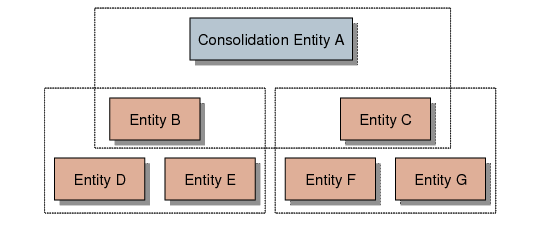
Example: An organization has subsidiaries represented by entities B and C. B in turn has subsidiary entities D and E, and C has subsidiary entities F and G. Perform consolidations for entities D and E in entity B, for entities F and G in Entity C, and finally for entities B and C in entity A.
Multi-Level Consolidation
You can perform initial consolidation to the transient layer. This lets you review the consolidated sets of accounts for missing postings. You can delete this consolidation, re-create the missing postings in the subsidiary accounts, and then consolidate again. When satisfied with your consolidation transactions, use Mass Layer Transfer to transfer the transactions to the official layer for reporting. See
Mass Layer Transfer.
You specify a consolidation daybook for each source layer you want to consolidate. For example, when you consolidate, the transactions in the official layer from all source entities are mapped to the official layer consolidation daybook in the consolidation entity. Since transaction numbers include daybook codes, you can identify the transactions from separate entities by their original daybook code when you are reviewing the consolidated transactions. For this reason, you should avoid using the same daybook codes in different entities when setting up daybooks.
The GL periods of the source entities to be consolidated must be locked before you begin the process. In cases where you need to go back and re-create missing transactions, you must unlock the period, complete the transactions, and lock the period again before consolidating again. See
Modifying Entity GL Periods.
You can include the following types of transaction in a consolidation entity:
• Journal entries, including reversing entries
• Recurring entries
• Revaluations
• Allocations
• Consolidation
You cannot consolidate into an account of type cross-company during a consolidation. These transactions could cross-reference entities that are not included as source entities in the consolidation. You can map the source cross-company accounts to standard accounts (which can be intercompany accounts) in the consolidation entity. This option is recommended. Alternatively, you can eliminate cross-company or intercompany transactions after consolidation. See
Set Up Intercompany Eliminations and
Intercompany Elimination Postings for more information.
You also cannot include year-end transactions because these transactions create incorrect or incomplete balances in the final consolidation.
The system also does not include transactions that reference both consolidation and non-consolidation entities, or that reference two or more consolidation entities. The system does not use source entity GL transactions posted to the transient layer for consolidation purposes.